Seeing Constellations Rather than Stars

When it comes to BIPOC students, we have a tendency to celebrate individual stars rather than seeing the larger constellations of which they are a part. Patrick Reyes offers some suggestions for how we might better appreciate the beauty and wisdom of the communities and traditions which have formed our students. In his new book, The Purpose Gap: Empowering Communities of Color to Find Meaning and Thrive (Westminster/John Knox, 2021), Patrick offers new metaphors and a different way of thinking about how to help students cultivate a sense of purpose and empower their communities.

Continue reading “Seeing Constellations Rather than Stars”

Belonging and Retention: It’s Not Rocket Science

A recent article in the Chronicle offers what may be a needed reminder about the importance of advising and the role it plays in fostering a sense of belonging for students.

A recent article in the Chronicle offers what may be a needed reminder about the importance of advising and the role it plays in fostering a sense of belonging for students. Aaron Basko, who previously worked at Salisbury University and is now assistant assistant vice president for enrollment management at the University of Lynchburg, wonders whether we have gotten student success “completely backward.” In our efforts to apply “complex technocratic approaches” to the problem of student retention, Basko writes, we forget to consider what makes students stay.

Continue reading “Belonging and Retention: It’s Not Rocket Science”

Jason Mahn on Neighbor Love

During the first few months of the COVID-19 pandemic, Jason Mahn (Augustana College, IL) began chronicling his “wondering and wanderings,” which are now published under the title Neighbor Love Through Fearful Days: Finding Purpose and Meaning in a Time of Crisis (Fortress, 2021). Some of his early musings on these themes appeared on this blog as “Neighboring and Sheltering in Place” (April 2020); “The Economy and Ecology of Neighbor Love” (May 2020); and “What An Unjust World Also Needs; Connecting Vocation and Activism” (July 2020).

In a new episode on the NetVUE podcast, we talk with Jason about his “in the moment” reflections about how we commit ourselves to loving our neighbors during times of social distancing, quarantine, protest, and social unrest. He writes about the threat of white supremacy, the challenges of repentance, and the importance of mundane acts. Jason urges us to resist stories that are too tidy in their resolution. 

Click here to listen to our conversation with Jason about “Neighbor Love.”

Jason Mahn is Conrad Bergendoff Chair in the Humanities and director of the Presidential Center for Faith and Learning at Augustana College in Rock Island, Illinois. He was a contributor to NetVUE’s second scholarly resources project volume, Vocation across the Academy. He is also a member of the NetVUE Advisory Council. To read Jason’s posts on this blog, including “The Tragedy of the Road Not Taken” which is among the most-read posts on this site, click here.

Vocational Gluttony and Our Fascination With Unity

In a recent essay in The Christian Century, L. Roger Owens confesses that he is guilty of what a wise friend dubbed “vocational gluttony.” Recognizing his own malaise in that descriptor, Owens wonders, “Was I greedy for excessive variety in my vocational pursuits? Was I refusing vocational simplicity, refusing to focus, to settle down, to be satisfied?”

Owens goes on to refer to the “trifecta” of Mary Oliver, Frederick Buechner, and Annie Dillard, writers who variously invoke the significance (and necessity?) of a one, true calling. There is a compelling power to the idea of a unified singularity when it comes to how we understand our life’s purpose.

Woodcut attributed to Albrecht Dürer from Ship of Fools by Sebastian Brant, published in Basel in 1498. Public domain, via Wikimedia Commons.

This is a theme that Daniel Meyers’ takes up in “Plurality of Vocations: Finding Seasons Rather than Singularity.” Daniel writes, “Vocation has too often been framed as a singular pursuit.  I hope imagining a plurality of callings might open new doors of reflection, new questions of discernment, and new ways of living out life’s many seasons.”

Ultimately, Owens’ settles upon the metaphor of a “through line,” the underlying reason for his many pursuits:

Vocation doesn’t have to be about focus, finding the one right thing, discerning the one right job, landing in the one right place. Instead, we might begin to discern whether there’s a through line that gives coherence to the variety of pursuits that call for our attention. We might look at our lives and say, Yes, these pursuits make sense as chapters in a coherent vocational story, even if on the surface the relationship among them is not obvious.

L. Roger Owens, “Vocational Gluttony,” The Christian Century (September 28, 2021)
Continue reading “Vocational Gluttony and Our Fascination With Unity”

Giving and receiving advice

Suggestions for how to use “Vocational Advice for Undergraduates” (podcast episode) in your work with students.

What advice would you give to a young adult today?

We ask a version of this question to each of our guests on the NetVUE podcast, Callings. The answers are varied, alternating between encouragement and gentle warning, the pragmatic and the more idealistic. In a “bonus episode” to round out season one, we compiled those words of advice in an episode called “Vocational Advice for Undergraduates.” The advice-givers include Darby Ray, Eboo Patel, Amanda Tyler, Rabbi Rachel Mikva, Father Dennis Holtschneider, and Shirley Showalter. 

At just over 30 minutes in length, the episode offers a taste of the other, hour-long conversations and our hope is that you will go back and listen to the ones that pique your interest, if you have not already listened to the earlier episodes.

Because of its brevity, and because the advice is directed at young adults, you might also consider using this episode in your work with undergraduates. Here are some ideas for how you might do that.

Continue reading “Giving and receiving advice”

Race/Class/Gender, Privilege, and Vocation

A compilation of blog posts on Vocation Matters (2018-2022). Some pieces will be meaningful to students while others are more relevant for prompting discussion with colleagues.

As you put together materials for teaching or programming with students, you may want to consider these posts about vocation that examine race, class, gender, social location, and privilege. Some pieces will be meaningful to students while others are more relevant for prompting discussion with colleagues.

On privilege (general)

Counter Story-telling in The Purpose Gap (April 2022)

Neighbor Love, on Jason Mahn’s new book (November 2021)

Vocation Revisited, Part 2 of a conversation about vocation and privilege (August 2021)

Attending to Voices (October 2020)

The Whispers of the Spirit”: Discerning Meaning in the Work of Justice (July 2020)

The Hard Realities of Reduced “Bandwidth” (June 2020)

Resiliency vs. Audacity (May 2020)

Privilege and Lies: Some Problematic Myths about Vocation (April 2019)

Vocation in an Interconnected, Interdependent World (August 2018)

On race and class

On the Problems with Colorblind Mentoring (April 2022)

Strength and vulnerability, an interview with Mary Dana Hinton (January 2022)

Transgressive Teaching, the impact of bell hooks (December 2021)

Seeing Constellations rather than Stars (December 2021)

The Push and Pull of Vocation in The Chair (October 2021)

Vocation Revisited, part 1 of a conversation about race, class, privilege, and interfaith engagement (August 2021)

The Gift of Intervention (December 2020)

To “Know Thyself” One Must “Know Thine History” (November 2020)

#Pissedoffpastor in Kenosha (September 2020)

The Power of Proximity on Just Mercy (August 2020)

Courageous Texts, Courageous Teaching (August 2020).

Wrestling with White Supremacy, about the work of Richard Hughes (February 2020)

Growing Up In Between: Some Thoughts on Formative Tensions and Vocational Discernment (July 2019)

Complex Turning Points: Vocation and Social Location (March 2018)

Vocation Enmeshed (October 2013)

On sexuality and gender

Queer Embodiment in a Vocational Journey (November 2021)

Conviction and Covering (September 2021)

Gay on God’s Campus, an interview with author Jonathan Coley (June 2021)

Coming Out Into Vocation (June 2021)

Dragged Into Vocation (June 2021)

For Young Women Who Have Considered Their Becoming (January 2019)

Other posts about diversity

Familismo, Success, and Service to Others (May 2022)

Twelve Ground Rules for Dialogues on Difference (November 2020)

Rethinking and Unlearning: Imagining New Ways of Being in Community, an interview with Nimisha Barton (October 2020)

Institutional Identity and Diversity (February 2020)

Building Multi-cultural Competency (January 2020)

The Change a Difference Makes (January 2019)


Last updated on June 5, 2022

Called to Advocacy

Amanda Tyler’s advice to college students: “Think intentionally, deliberatively, and if its your practice spiritually, about your next move but worry less about the chessboard. I couldn’t have played out all these moves to get to this place, and yet it feels like the perfect place for me.”

Amanda Tyler is the executive director of the Baptist Joint Committee, which is headquartered on Capitol Hill and advocates for religious freedom for all. “From a very early age, I felt a calling to law and politics – I wanted to be a public servant in some way,” she shared during a recent conversation captured in the latest episode on the NetVUE podcast series, Callings. The episode is called “The Next Move.”

In 2019, Amanda was named “Baptist of the Year” for her leadership in the Christians Against Christian Nationalism campaign. We talked about this aspect of her work during our conversation, and she described how we are called to walk a line between fidelity to the past and stewardship for the future. (Amanda was recently interviewed on NPR’s “All Things Considered” on the topic of Christian Nationalism).

Continue reading “Called to Advocacy”

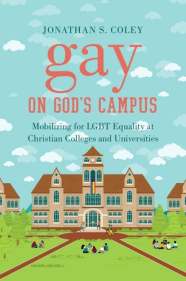
Gay on God’s Campus

An interview with sociologist Jonathan Coley, author of Gay on God’s Campus: Mobilizing for LGBT Equality at Christian Colleges and Universities (University of North Carolina Press, 2019).

An interview with Jonathan Coley, author of Gay on God’s Campus: Mobilizing for LGBT Equality at Christian Colleges and Universities (University of North Carolina Press, 2019). Trained as a sociologist, Jonathan previously taught at Monmouth College in Illinois and now teaches in the Department of Sociology at Oklahoma State University.

Tell us about the book.

The book examines activism by LGBTQ students at Christian colleges and universities. There’s a lot of research out there about how students who are LGBTQ struggle to reconcile their religion, sexuality and/or gender identity on their campus and experience various kinds of trauma on non-affirming Christian campuses. I wanted to understand how LGBTQ students become agents of social change. I examine why students join or form LGBTQ activist groups on their campuses, why they commit to activist groups and sometimes devote several years and many hours a week toward the cause of promoting LGBTQ inclusion on their campuses. I examine what kinds of changes LGBTQ students bring about on their campuses and the strategies and tactics they used to bring about change, and then I consider how students themselves are impacted by their participation and LGBTQ groups on their Christian college and university campuses. I myself attended a Baptist University (Samford University in Alabama) where I worked with other students to start an LGBTQ student group. So this project has personal roots.

Continue reading “Gay on God’s Campus”

Becoming Big

As much as I had struggled before I joined the church, once I submitted my little life, I wanted it to count. I hadn’t yet given up on the dream of becoming big. – Shirley Showalter, Blush: A Mennonite Girl Meets a Glittering World.

In her memoir Blush Shirley Showalter shares stories from her childhood, including how she negotiated the emphasis in her Mennonite community on being “plain” and the admonition against feeling “big.” In a new episode of the NetVUE podcast series, Callings, Shirley talked with us about writing the memoir and what that process taught her about narrative and story. She relays some of the twists and turns in her own life, including the call to the presidency of Goshen College. With a new book coming out next year on grandparenting, co-written with Marilyn McEntyre, Shirley also talks about what it means to embrace becoming an elder. When asked what advice she would give to young adults today, she warned against listening to pre-fabricated advice from others: “Your vocation to yourself and to your own spirit is your highest vocation.” 

Continue reading “Becoming Big”

Pivotal Moments

An interview with Scott Mattingly, Associate Dean of Academic Life at DeSales University about a new course he developed called “Pivotal Moments: Fulfilling Your Potential in Times of Change,” which was featured in a recent Teaching newsletter published by The Chronicle of Higher Education. Scott taught a pilot version of the course as a one-credit elective this past spring. The interview has been edited for this blog.

Tell us a little bit about the course and how it came into existence. 

I am part of a group at DeSales University that has been charged with facilitating a faculty-driven process for revising our general education curriculum. As that process has unfolded, we have come to believe that we need a capstone course and we are interested in giving students an opportunity to bring together the entirety of their experience, inside and outside the classroom. And the mission of our institution emphasizes more than just job preparation; the importance of holistic well-being, thriving rather than just surviving – those are also important components of a DeSales education. So another aspect to this capstone is that we want to give students a chance to reflect on their identity and purpose – the existential, big questions. So that’s where I started, where we started.

I was pondering that in the back of my mind and then we had these twin pandemics in 2020 with the killing of George Floyd and obviously COVID-19. And I found myself thinking that our students need a way to process what is happening. They are going to do that as part of their social networks and there are probably some courses where it might come up, and maybe some opportunities for programming that students could optionally choose to attend where these things might come up, but I felt like there needed to be something a little more intentional, a little more structured, something that involved the faculty in guiding students through that process.

Continue reading “Pivotal Moments”