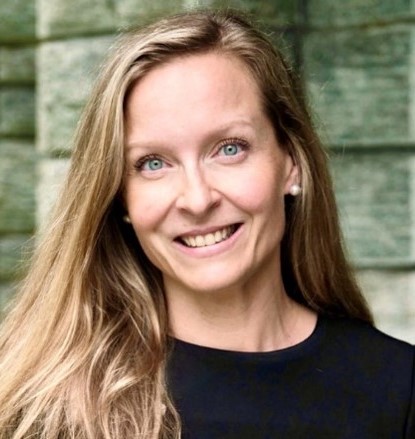
For Almeda Wright—who’s featured in the most recent episode of NetVUE’s podcast, Callings—human flourishing depends in large part on a vision of abundance, resilience, and thriving. She notes that it does not mean that everything in our lives always goes “perfectly well,” but we do have to have “the support and the resources to encounter whatever emerges.” Even amidst difficulty, we have the capacity to flourish. “When hard times come,” she notes, you can still thrive, if “you feel that there are resources, communities, people, a sense of purpose, a sense of calling, a sense of God, or a spirituality that allows you to face it and not be overwhelmed by it.”
The latest NetVUE podcast episode features Jessica Riddell, a professor and researcher advocating for transformative change in higher education. In her book “Hope Circuits,” she explores fostering hope, equity, and creativity within universities. Riddell emphasizes renovating existing systems rather than destroying them, aiming for integrity and human flourishing.
Jessica Riddell
The most recent episode of NetVUE’s podcast Callings features Jessica Riddell, a speaker, professor, and researcher who focuses on systems change in higher education. Jessica’s recent book, Hope Circuits: Rewiring Universities and Other Systems for Human Flourishing, and her previous co-authored book, Shakespeare’s Guide to Hope, Life, and Learning, cover various facets of educating and leading across the university. Jessica is a professor of early modern literature at Bishop’s University in Quebec, Canada, where she also holds the Stephen A. Jarislowsky Chair of Undergraduate Teaching Excellence. She is the founder of the think tank Hope Circuits Institute and sits on the board of directors for the American Association of Colleges and Universities. In all these roles, she participates in a wide range of conversations at national and international levels about how universities fulfill the social contract to our broader society.
Committed to cultivating hope in higher education, Jessica wrote Hope Circuits to challenge educators to reconsider the assumptions with which we operate. In it, she offers innovative tools that emerge out of the stories of luminaries she gathered for the project and helps us come to a clearer understanding of systems of governance, leadership, and institutional culture so that everyone in the university can flourish. But such flourishing isn’t limited to higher education, which she argues plays an important role in fostering creativity and democracy across sectors. “Higher education,” she says, “is the place where we keep democracy and ourselves alive and awake. And my goodness, we need to stay alive and awake at this moment.”
Anna Bonta Moreland, a humanities professor at Villanova University, discusses her new book, The Young Adult Playbook, designed for undergraduates. It offers guidance on vocational reflection and emphasizes the importance of work, leisure, and relationships for a fulfilling life. Moreland aims to empower students to pursue meaningful lives beyond graduation.
Anna Bonta Moreland
In April, NetVUE’s podcast Callings released an episode that featured an interview with Anna Bonta Moreland. A professor of humanities at Villanova University, Anna also holds the Anne Quinn Welsh Endowed Chair and directs the university’s honors program. While her academic expertise and research include medieval theology, interfaith dialogue, and comparative theology, she has also become passionate about educational renewal and the character and leadership formation of her students. She’s received both Templeton and Lilly Endowment grants for her work in these areas.
Recently, Anna coauthored The Young Adult Playbook: Living Like it Matters with Thomas Smith. Specifically written for undergraduates, the book invites them into and guides them in vocational reflection and discernment. But for Anna, writing the book represented her own vocational shift. It emerged out of a course she has been teaching senior honors students for the past eight years called Shaping an Adult Life—a course that helps these students, as she notes, “look beyond graduation and think about a life well lived as an adult.” While teaching the course, she felt “like I had put my finger on the raw nerve of my students’ lives,” and their “visceral” response to the course prompted her to write the book as a sort of “palate cleanser” from her previous scholarship. But it served as something more than a temporary shift in her own life as a writer, something much more significant. “This supposed palate cleanser,” she observed, “has ended up just becoming where I am, and I don’t want to leave.”
The latest episode of NetVUE’s podcast Callings features Carlo Rotella, a writer and professor at Boston College. His book, What Can I Get Out of This?, explores teaching undergraduates and emphasizes meaningful engagement in the classroom. Rotella advocates for seeing education as a practice requiring persistence and presence, underscoring its relevance beyond mere career preparation.
Carlo Rotella
NetVUE’s podcast Callings has released a new episode, which features an interview with Carlo Rotella, an award-winning writer and professor of American Studies, English, and journalism at Boston College. His most recent book,What Can I Get Out of This?: Teaching and Learning in a Classroom Full of Skepticsgets at the heart of what it means to teach and to learn together with undergraduate students today. Carlo has been a regular contributor to The New York Times Magazine since 2007. His work has appeared in collections like The Best American Essays, as well as The New Yorker, Harper’s, Chicago Tribune, Boston Globe, Slate, and various scholarly periodicals. Recurring subjects in his writing are cities and city life, boxing, music, crime, basketball, neighborhoods, and how people get good at things. He is co-editor and founder of the University of Chicago Press’s Chicago Visions and Revisions book series.
As his career and his most recent book illustrates, Carlo is interested in the nuts and bolts of teaching—what he considers its craft and the ways we can build classroom experiences that help our students make meaning. The book follows the experience of a single cohort of students in a required introductory literature course, most of whom are not English majors. In it, Rotella tells the story of what happens when students practice discussing ideas and readings with each other over a semester and then follows up with them a few years later, revealing that the course’s impact yielded an impactful return on investment in one’s education and life. As he describes it, one of the things it explores is “how to be a student, how to do college,” helping educators better understand how our students experience and live out their vocations as students.
In a recent episode of NetVUE’s podcast Callings, Angela Duckworth discusses her book “Grit” and the significance of passion and perseverance. The conversation touches on mentoring, the importance of connection in education, and the relationship between human flourishing and serving others. Duckworth emphasizes goal setting and intentionality in pursuing one’s vocation.
Angela Duckworth
NetVUE’s podcast Callings recently released an episode featuring an interview with Angela Duckworth, the author of the well-known book Grit: The Power of Passion and Perseverance, a number one New York Times bestseller. Her TED talk on this topic is one of the most watched of all time. A 2013 MacArthur Fellow, Angela is the Rosa Lee and Egbert Chang Professor in the department of psychology and faculty co-director of the Behavior Change for Good initiative in the Wharton School, both at the University of Pennsylvania. Angela’s wide experience includes having advised the World Bank, NBA and NFL teams, Fortune 500 CEOs, as well as working as a math and science teacher in the public school system. She founded a summer school for underserved children and co-founded the Character Lab, a nonprofit dedicated to advancing scientific insights that help children thrive. Angela holds degrees from Harvard, Oxford, and the University of Pennsylvania.
The latest episode of NetVUE’s podcast Callings features Barbara Brown Taylor, a renowned author and public theologian. She discusses the importance of recognizing personal and external callings, emphasizing the value of small, local actions. Taylor encourages prioritizing life-affirming pursuits and remaining attentive to personal vocations amidst life’s demands.
Barbara Brown Taylor
NetVUE’s podcast Callings has released its first episode of the new year, featuring New York Times best-selling author Barbara Brown Taylor. In addition to the many award-winning books that she has written—including Holy Envy, Learning to Walk in the Dark, and An Altar in the World—Barbara has served as an Episcopal priest, a teacher, and a public theologian. For many years, she held an endowed chair in religion and philosophy at Piedmont University, a NetVUE member institution, and she has served on several seminary faculties as well as the theological studies certificate program at Arrendale State Prison for women. Barbara has been recognized as one of the most effective preachers in the English-speaking world by Baylor University, and in 2014, Time magazine included her on its list of “The 100 Most Influential People.” She has been named the Georgia Woman of the Year and recently elected to the Georgia Writer’s Hall of Fame. And beyond all these accolades, she continues to write and speak and serve as the caretaker of a farm in rural Georgia.
In a recent NetVUE podcast, Maria LaMonaca Wisdom discusses her role as assistant vice provost for faculty advancement at Duke University. She emphasizes the importance of mentoring in fostering growth and personal relationships, while highlighting the need for revision and change in vocational paths. Mentors illuminate potential and inspire hope in students.
Maria LaMonaca Wisdom
In the most recent episode of NetVUE’s podcast Callings, hosts Erin VanLaningham and John Barton interview Maria LaMonaca Wisdom, a leading voice on mentoring and coaching in higher education. Maria is the assistant vice provost for faculty advancement at Duke University, where she focuses on helping faculty flourish as researchers, educators, mentors, and leaders. In this role, she offers group coaching programs along with 1:1 coaching to faculty at critical transition points of their careers. She is also the author of How to Mentor Anyone in Academia, published recently by Princeton University Press, which offers methods and approaches to understand the mentor role. No stranger to undergraduate education, Maria is a former Lilly Fellow and holds a PhD in English; she taught literature for a decade at a small liberal arts college before pivoting to her work as an administrator.
Willie James Jennings, an esteemed theologian at Yale Divinity School, emphasizes the importance of belonging in education through his insights shared on NetVUE’s podcast. He advocates for educators to engage with students as fellow learners and highlights the need to confront racial injustices within education systems while committing to challenging antisemitism and advocating for Palestinians.
Willie James Jennings
The most recent episode of NetVUE’s podcast Callings features an interview with Willie James Jennings. Willie is the Andrew W. Mellon Professor of Systematic Theology and Africana Studies at Yale Divinity School. A highly sought-after speaker, Willie teaches and writes in areas that include theological anthropology, liberation theologies, cultural identities and race theory, and environmental studies. He is the author of numerous articles and several award-winning books. He is also an ordained Baptist minister, and before completing a Master of Divinity from Fuller Seminary and a PhD from Duke University, he received his undergraduate education from Calvin University, a NetVUE member institution. Willie was also the keynote speaker for the NetVUE Unconference in March of 2021.
In the second episode of NetVUE’s podcast Callings, hosts Erin VanLaningham and John Barton interview Michael Lamb, a faculty leader at Wake Forest University. He discusses ethics and the importance of virtues in public life, encouraging listeners to connect passions with community needs and to cultivate virtues in discovering personal callings.
Michael Lamb
In the second episode of this season of NetVUE’s podcast Callings, hosts Erin VanLaningham and John Barton interview Michael Lamb, the senior executive director of the Program for Leadership and Character at Wake Forest University. An associate professor of interdisciplinary humanities and the F.M. Kirby Foundation Chair of Leadership and Character at Wake Forest, Michael also serves as an associate fellow of the Oxford Character Project at the University of Oxford in the United Kingdom, a project which helps graduate students in various fields, including government, law, medicine, business, and academia, think about the role of ethics in their professions. Michael’s research and teaching focuses on the ethics of citizenship and the role of virtues in public life, all of which offers many connections to the exploration of vocation.
The sixth season of NetVUE’s podcast Callings features Lee C. Camp, a public theologian and educator. Camp discusses vocational questions in higher education, emphasizing the importance of asking deeper questions about life’s meaning. He encourages students to pursue larger, more truthful narratives to foster meaningful lives and societal impact.
Lee C. Camp
NetVUE’s podcast Callings has launched its sixth season with an episode featuring Lee C. Camp, host of the podcast and nationally syndicated public radio series No Small Endeavor. In this show he’s explored what it means to live a good life in conversation with some of the country’s most notable philosophers, scientists, entertainers, and politicians. Lee is also the Distinguished Faculty Fellow at Lipscomb University, a NetVUE member institution. As a public theologian, author, and social commentator, Lee’s work focuses on Christian ethics, the intersection of faith and politics, and the meaning and pursuit of human flourishing.
In his conversation with hosts Erin VanLaningham and John Barton, Lee brings a wealth of experience to bear on questions of vocation in higher education. In the process, he challenges more simplistic and subjective notions of “meaningfulness,” which can often overemphasize our individual needs and perspectives. Instead, he encourages us to be good question-askers. “If we can give our students a better set of questions than the questions that they have,” he says, “it will change their lives.” For Lee, these questions often emerge out of the kinds of stories we live our lives by. He urges all of us, but especially undergraduate students, to expand the moral scope of these stories and consider this question: “Am I trying to live by a big enough, true enough story?” he asks, for “if you try to live by a too small, not true enough story, it can cause all sorts of horrific damage, to yourself and the world around you.” Ultimately, Lee encourages listeners to embrace the exciting adventure of living out these larger stories and creatively pursuing the virtuous life.
Click hereto listen to the episode featuring Lee C. Camp, “A Big Enough Story.”