
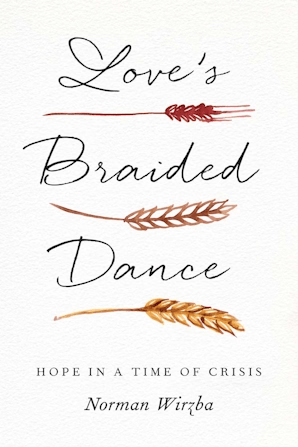
A series of reflections on Norman Wirzba’s Love’s Braided Dance: Hope in a Time of Crisis and NetVUE’s 2026–2027 Big Read program.
In the first chapter of Love’s Braided Dance: Hope in a Time of Crisis, Norman Wirzba observes that to harness the powerful joy of authentic embodiment for our shared work, “people need the support of a loving community that affirms and encourages them.” One of the purposes of NetVUE’s Big Read program is to foster this kind of support at its member institutions and to do so by reading a book like Love’s Braided Dance together in community. Such communal meaning-making has the potential not only to help us all deepen our practices of vocational exploration, but also to affirm and encourage us in the process.
To that end, Vocation Matters has invited three colleagues—Tara Russey, Craig Mattson, and Anna Stewart—from across the network to reflect on this year’s Big Read. In their reflections, they share powerful glimpses into what moved them and striking insights into what they found significant. In this way, they illustrate another key point from Wirzba’s opening chapter: “The most important thing” to do, he writes, “is to act on the conviction that your community needs you and is calling you to contribute in some way.”
As you reflect on their contributions, please consider them as points of departure as you and colleagues explore what significance this book might have at your institution. I think you’ll agree that we all need, and will be enriched by, the loving, resonate insights that each writer offers us.
Tara Russey, Washington & Jefferson College
Although I approached Love’s Braided Dance with a sense of optimism because of its NetVUE provenance, I wasn’t sure what to expect from it. I’m a big fan of love and hope, and looking around me, signs of crisis are evident. Still, sometimes books on such topics can leave me a little cold, feeling bucked up but fundamentally unchanged (though maybe that’s just me, and the books I pick up—then put down).
Not so with Wirzba’s book. It opens with the moving story of Carmine Menna, whose small boat encountered hundreds of drowning refugees on an evening pleasure cruise with friends in the Mediterranean. At physical and legal peril, Menna and his friends saved 46 people in their 10-person craft, while another 368 perished.
Wirzba explores the intense connection Menna felt with the people he brought aboard; beyond offering mere meditations on love and hope, the book issues an instructive call for interconnectedness. In chapter after chapter, Wirzba explores moments of interdependence, forgiveness, reconciliation, and restoration, even amidst historic atrocities.
For example, he contrasts generative ecosystems with the architecture at Treblinka, noting that automated genocide fit perfectly on a foundation that we have not fully dismantled and that continues to prioritize efficiency, isolation, and violence. Yet, he fosters in the reader the conviction that mending the torn fibers of our humanity is achievable, joyous work.
I read this book at a moment of change at my institution. Like many such moments, this one induced some anxiety, this time in me and my faculty colleagues. Seemingly picayune questions (“Where will I park?” and “Is that bus shelter really being constructed in a giant puddle?”) were, at their heart, about profound and tender issues like “Does my work matter?” and “Are decisions being made with care for our community?”
I found myself surveying my own interior. I’d once written a dissertation on Thoreau and Emerson. Thoreau wouldn’t be dispirited by the displacement of his Toyota Camry; he would find damp boots bracing! But it wasn’t self-reliance that stabilized and comforted me. It was knowledge of my colleagues, who over decades of work together have sheltered and nurtured one another and our students, covered or not by haphazard structures. Wirzba’s book reminds me that in painful and joyful moments, our instinctive reach for one another is not an expression of weakness, but an affirmation of life.
Craig Mattson, Calvin University
This past August, on a shivery late-summer night, I joined friends for a Brandi Carlile concert in Grand Rapids, Michigan. Before the show, we sat at the amphitheater’s edge, watching the light of the sunset fall over the town, talking about how things were feeling at our university. It’s an uneasy season—an era when everybody’s wishing for reassurance, hoping that things will be (as another colleague of mine has put it) some version of okay.
But reading Love’s Braided Dance has made me want to resist this beguiling wish.
Early in the book, Wirzba notes the widespread predilection to ask, “What’s giving you hope?” The passage made me wonder if the author has been surveilling my conversations. As I seek reassurance, I ask that question, in one form or another, every day of my life:
- Has it always been this intense?
- Have we weathered worse times?
- Are there signs that things might get better?
- Are we going to make it?
Halfway through Love’s Braided Dance, Wirzba calls readers to notice a desire that runs deeper than any craving for reassurance: the yearning for what the sociologist Hartmut Rosa calls resonance. It’s a somewhat elusive experience of mutuality with others, with the world, with whatever and whoever is beyond the world. In contrast with the control-ridden craving for reassurance, the desire for resonance prompts us to seek not what provides certainty but what strengthens affection.
Wirzba’s counter-question to “What’s giving you hope?” is “What do you love?” The latter question teaches me to hope for something other than a sureness and to develop a fluency that manages the unmanageable and countenances the horrific risks of our technological and environmental moment.
Wirzba’s question won’t eliminate those risks, but it does show how to stand in their midst. His epilogue encourages not calm productivity but what the renowned dancer Martha Graham describes as an “an eagerness to meet life.”
Last night, in her anthemic invitation, “Hold out Your Hand,” Brandi Carlile belted out the question, “Don’t you wanna dance?” And Wirzba’s book, even in a time of tremors and fears, makes me want to stand up and hold out my hand with the biggest “Yes!” that my soul can sing out.
Anna Stewart, Valparaiso University
“Hope is born in spaces of vulnerability,” writes Norm Wirzba in the first chapter of Love’s Braided Dance.
I find myself drawn to his evocative language in this quotation and elsewhere even as I shrink from its weighty substance. What does it mean for people to “open themselves to, and allow themselves to be moved by, whatever trouble and whatever goodness are happening around them?”
I witnessed a glimpse of what this passage might mean several weeks ago when a massive derecho storm ravaged northwest Indiana, leaving in its wake uprooted silver maples and black walnuts splintered among tangled power lines. My daughter quietly remarked, “Those trees make my heart hurt.” Days later, my thirteen-year-old son wiped out on his bike. Hunched together in the sterile white light of the emergency bay, we were grateful that he suffered only a broken arm, a few cuts, and some painful road rash. For over a week, there was no electricity at home, and communication was limited as cell service cut out unpredictably. Everything felt very close to the surface, charged and fragile. Despite these challenges, I was and am aware of the uncomfortable inequalities laid bare across our region, where recovery and restoration continue to arrive more slowly for neighbors living across county lines.
Reading Wirzba feels providential against this backdrop, reawakening me to the beauty and fragility of all things. In the day-to-day cadence of ordinary life, I’m frequently insensitive to the interdependence connecting us to each other as humans and to the natural world we too often overlook. My sudden reminder of creaturely finitude extends anew the gift of “resonance,” of which Wirzba writes (drawing on sociologist Hartmut Rosa and Henry David Thoreau), “The best life is one that attunes itself to the places we are in and to the diverse creatures we are with. The best life is a resonant life that, like a tuning fork that responds to the vibration of another tuning fork, vibrates to the pulsing life of others.”
Contemplating ourselves as tuning forks feels both necessary and vocational to me. I’m conscious of the generous “tuning” around me—from the Good Samaritans who came across my son and paused their days to tend him, to the shading sanctuary of undamaged trees, shielding us from late summer heat. Life teems, and it is not only hope that seems born in this beautiful, vulnerable mutuality. It is vocation itself, a powerful calling if we will but listen and heed.
If you missed the first post in this series on NetVUE’s Big Read selection for 2026–2027, you can still access it. Check it out for more information about the Big Read program and how NetVUE members can participate in it as a way to build community and deepen their understanding of vocational exploration.
Tara Russey is professor and chair of the English department at Washington & Jefferson College in Washington, Pennsylvania, where she teaches courses on American literature, Asian American literature, the memoir, and introductory and professional writing. Her academic writing has been published in MOSAIC, ESQ: A Journal of the American Renaissance, Pedagogy, and elsewhere, and her autobiographical writing has been published in The Cincinnati Review and in The New York Times. She was a participant in NetVUE’s 2026 Writing Colloquy.
Craig Mattson teaches at Calvin University where he holds the Arthur H. DeKruyter Chair in Faith and Communication. He and his wife Rhoda enjoy hiking, playing pickleball, and walking their dog Chaucer. Craig has written three books, most recently, Digital Overwhelm (Cascade, 2024) and produces the work-culture newsletter for mid-level leaders, The Mode/Switch. In 2026, he participated in NetVUE’s Enhancing Vocational Exploration seminar.
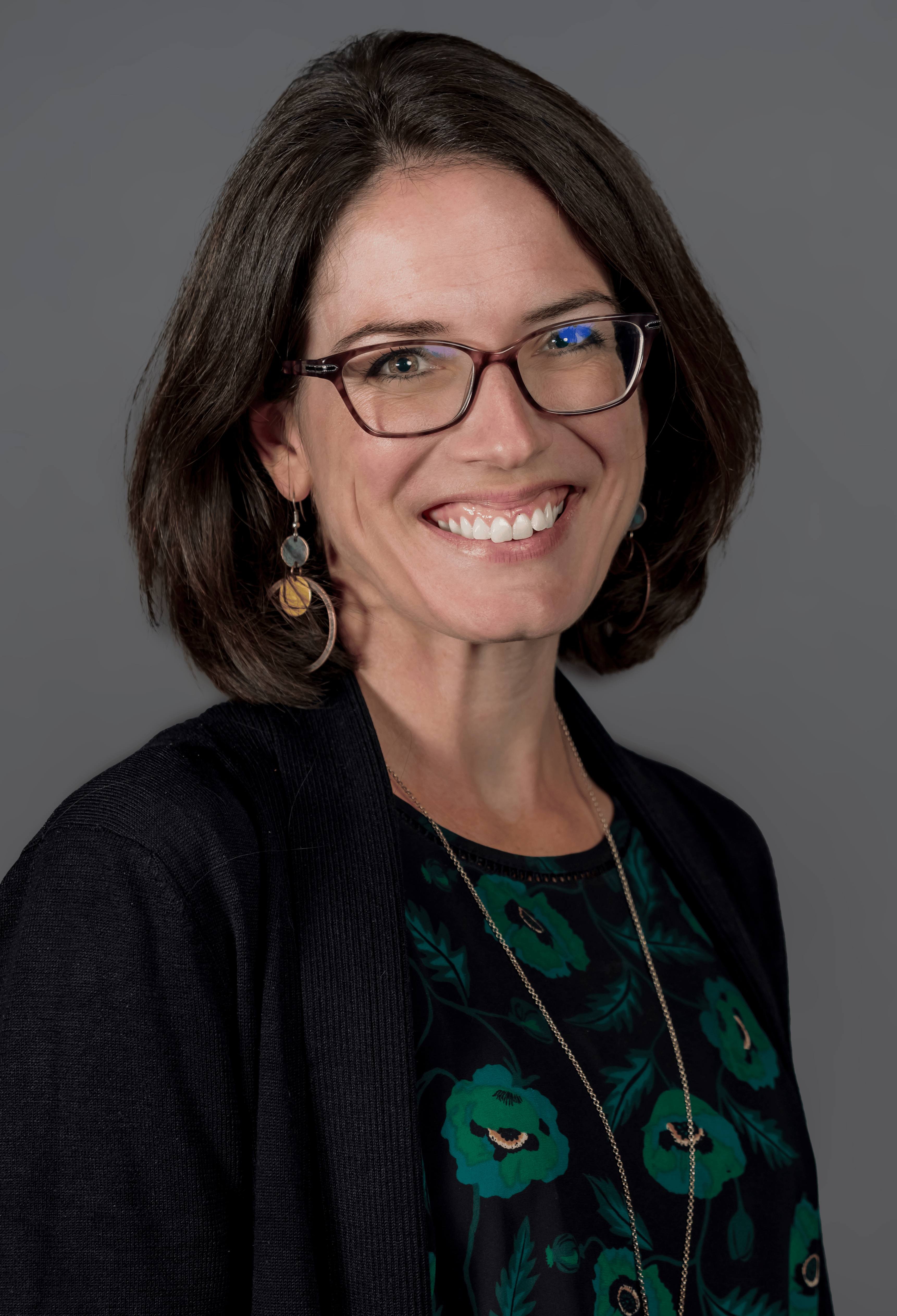
Anna Stewart is the Bonnie & Peter Raquet Director of the Institute for Leadership and Service at Valparaiso University, where she also serves as director of programs for the division of calling and spiritual life. A member of NetVUE’s 2026 Enhancing Vocational Exploration seminar, Anna co-facilitates a Valpo faculty and staff learning community through a program development grant that is focused on clarifying and advancing an integrative vocational framework for experiential learning. She is interested in the intersection of vocational reflection, cross-campus programming, and narrative (both individual and communal).
Geoffrey W. Bateman is the editor of Vocation Matters and NetVUE’s director of strategic communications. In 2017, he participated in the inaugural NetVUE faculty seminar on Teaching Vocational Exploration, and his essay, “Queer Vocation and the Common Good,” appears in the fourth volume of the NetVUE Scholarly Resources Project, Called Beyond Our Selves: Vocation and the Common Good (Oxford, 2024). He contributed “Queer Callings: LGBTQ Literature and Vocation” to Cultivating Vocation in Literary Studies (Edinburgh, 2022), and is a professor of criminology, sociology and justice studies at Regis University.