

A series on how to help our students strengthen their abilities to pay attention to their lives, the world, and their vocations.
When I talk with students about the purposes of class discussion, I often show them the dinner scene from my favorite Sandra Bullock film, While You Were Sleeping. I ask them to describe what they observe about the quality of the conversation happening around the dinner table, and especially to note who seems to be listening. This scene helps us distinguish between dialogue, a method of building on each other’s ideas, and conversation that proceeds more like a set of disconnected monologues (however humorous).
Students often zero in on a key difference between the two. They note that in a dialogue, participants actively listen to understand each other. In the other kind of discussion, people listen for a break in the conversation to make space for their own voice.
It is easy to make the case to students that listening is hard, and as a culture, we are not very good at it. It is harder to explain how we can get better at it. Naming the classroom an attention gym—as I described in my first post in this series—provides the framework to highlight attention as a key resource in becoming a better listener. Class discussions then become the training ground for workouts in listening.

Building attention for listening can emphasize this skill as vocational practice. As Parker Palmer notes in Let Your Life Speak: Listening for the Voice of Vocation, “Vocation does not mean a goal that I pursue. It means a calling that I hear.” To hear a calling, Shirley Showalter argues that we need two different capacities for listening. The first is listening to ourselves or locating an “internal call.” The second is “listening to the external world” or attending to the differing perspectives of others, including classmates.
Showalter bemoans the lack of resources for explicitly teaching listening as a skill in undergraduate education. But the field of communication studies offers rich insights into how listening works, which can help teachers in all disciplines address this challenge. Drawing on student-friendly summaries of some of this disciplinary knowledge can be a good starting place for engaging students in conversations about how difficult listening is and why we need practices to help us develop better strategies to do it well.
My own thinking about creating a classroom culture to improve students’ listening skills has been profoundly shaped by my involvement with the nonprofit organization, Essential Partners, which has allowed me to facilitate Dialogic Classroom workshops. In a guide to dialogic pedagogy, my co-authors and I argue for using dialogic classrooms that are based on Essential Partners’ model of Reflective Structured Dialogue and are built around listening as a central value. In this way, dialogic pedagogy is well-suited for helping students practice listening as an attention-oriented capacity that they need for vocational discernment.
Here are a few dialogic practices that can orient a class towards stretching and strengthening their listening muscles:
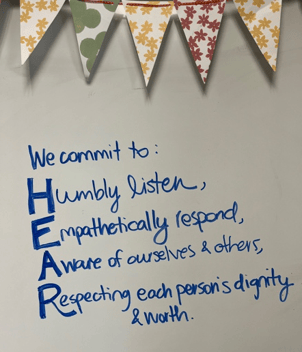
Building community agreements by asking students to think about what will help them listen to others’ perspectives, especially when they find them challenging. In her teaching, Rachael Baker creates these kinds of shared commitments to help students increase their sense of belonging. She asks, “What would have to be true for you to build and participate in a learning community?” In my classes, I alter that question slightly to focus on listening as a key component of that participation. I first ask students to think of a time when they felt intentionally listened to by someone else. I follow up with these questions: How did you know they were listening? What was its impact on you? How did you respond? Then, I ask them to think of a time when they intentionally listened to someone else. What made that possible? What did you do and not do? What might this suggest about the commitments we might need to make to one another in this class? After some sharing from these reflections, students brainstorm agreements in small groups, and then as a class we collaborate to build a more comprehensive list of expectations.
Reading about the importance of listening as a key feature of learning. Before our agreements exercise, I ask students to read “Humble Listening in Local Writing Communities,” a chapter from Richard Gibson and James Beitler’s Charitable Writing, and Sherry Turkle’s “Stop Googling. Let’s Talk.” We use those readings to identify values about listening and attention that we want to promote in our classroom. Gibson and Beitler make explicit that doing so can function as a workout: “Listening, like so many of the routine activities of our day, is a training ground for virtue,” particularly the virtue of humility. “Humble listening,” they note, “involves paying careful attention to our neighbors and their ideas,” and such listening “receives in order to respond and responds in order to receive still more.” Students are quick to point out that listening in this way—as a kind of “art of enrichment”—is rare. They acknowledge that they need to be intentional about practicing it when their classmates are speaking.
Reframing regular classroom routines as listening workouts. Once we’ve affirmed listening as a value and created our agreements, I remind students of our commitment throughout the semester by renaming regular class activities. Reading quizzes become listening assessments. Annotations become responses to what you’re hearing from an author. Group work becomes a method for testing how well you listen to your classmates’ perspectives and can restate their ideas: when they share out, I prompt them, “Tell me what you learned from listening to your group.” Feedback letters begin with, “In this essay, I hear you saying …” When students are sharing project ideas, they interview each other, and the goal is to keep asking questions to keep the other person talking until you hear the chime, listening well enough to be able to summarize what they heard in ways the speaker would recognize.

In a final reflection of a recent class, a student wrote that she found herself practicing listening habits she’d been developing in class in her personal relationships. She said that she’d realized that she often “listened to fix, to offer a solution,” rather than listening to offer support, to comfort, or simply be present. By becoming more aware of this tendency, she wrote, she was better able to alter it.
In the inaugural issue of Studies in Vocation and Calling, David Cunningham notes that one distinctive feature of vocational exploration and discernment is that it is a lifelong exercise in hearing and responding. “As we move through life,” he writes, “we shift and change, and this requires us to return to the exploration and discernment process again and again, to consider whether our present selves are discerning the same call that shaped our selves in the past.”
The move this student describes—noticing a pattern of listening she wanted to work on and then committing to improving it—seems to me exactly the skill required for vocation as a “lifelong exercise” in listening and discerning. In the attention gym, we talk about repeatedly stretching our capacities to the limit to engender growth. My hope is that, with practice, these patterns of attention become second nature, as familiar as riding a bike or serving a tennis ball, for those who have put in the effort to learn them.
Jennifer Ellis West is associate professor of English and director of core writing at Samford University in Birmingham, Alabama, where she teaches first-year and upper-level writing courses and leads a lively community of fellow writing teachers. She is the co-author of The Dialogic Classroom in Higher Education: Revolutionary Listening for Curiosity, Engagement, and Deep Listening. An academic associate for Essential Partners, she is also a NetVUE faculty fellow and participated in the 2026 NetVUE Writing Colloquy. Visit Jennifer’s author page on this blog for other posts in this series.