

The final post in a series on the role that community-engaged learning can play in vocational exploration and discernment.
As educators, we want to know that our efforts impact our students, but assessment is difficult, especially when we seek to measure learning about vocation. It requires that we—alongside our students—engage in “continuous, connected, challenging and contextual” reflective practice, as recommended by one practitioner’s guide. Our last post illustrated how teamwork can be a kind of vocational praxis, offering students the opportunity to discover common ground in community with others. In our final post, we describe the outcomes of Heather and her colleague Erin Olsen-Telles’s learning, paying particular attention to the impact of embedding reflection in community-engaged learning on students’ vocational discoveries. By redesigning assessment strategies, we came to understand that reflection grounded in community contexts empowers students to engage in the deeper learning that opens the door to vocational discernment.

Reflection offers a fertile pathway to explore many student identities; in particular, we focused on those of student-athletes, who are a significant population on Grand View’s campus. As Angie Morenz writes, “being a student-athlete is deeply rooted in who they are, not just something they do.” Heather’s desire to tap into these realities led her to design a community-based seminar on youth sports, which included reflection tools to aid students in their vocational exploration and to help them more fully understand their inner selves and the world around them. According to the authors of The Student Companion to Community-Engaged Learning, “reflection is the process of making meaning of experiences by integrating our intellectual, emotional, and spiritual responses to them. It’s the enactment of intellectual curiosity and open-mindedness, tempered by humility and infused with empathy.”
Barbara Bassot points out that this process takes repeated practice: to learn how to reflect and generate meaning is a skill to be honed and applied over the course of our lives. By encouraging students to develop these capacities, we also enhance their capacity for ongoing vocational exploration. As David Cunningham writes, this process is “not a once-and-for-all-decision about one’s direction in life (as if that were truly possible!), but rather an ongoing endeavor that each of us will continue to ‘practice’ across an entire lifetime.”
When I, Heather, taught the seminar on youth sports for the first time, I linked reflection to a teaching project on sports that I developed in partnership with a local elementary school. In this assignment, my students showed fifth graders the value of sports, created a lesson plan about a specific game or physical activity, and reflected on their teaching afterwards. Students processed their experience with a focus on three specific skills: teamwork, intercultural competency, and reflection. These skills provided the ideal foundation for them to build and practice their capacities for civic engagement.
After an initial review of the reflections, we realized that the prompts—focused on lesson planning and implementation rather than deeper meaning—had produced less insightful reflections than they had hoped for. We asked, “How could we prompt more meaningful reflection?” and wondered if we revised the prompts and grounded them in vocation, could they address these gaps? As Marina Harvey and her research partners conclude, teachers, like students, benefit from their own reflective practice. Our reflection prompted us to construct new rubrics for the following semester, and we returned to our original set of artifacts to reassess the student reflections. As we engaged in our own reflective process, we began to see that our students were learning a process of vocational discernment, which helped us devise a model that situated civic engagement within as a process of reflecting and building intercultural competencies.
Our diagram below visualizes the process of vocational discernment as it is enhanced through the practice of teamwork and intercultural competency. As students work with others and reflect on those experiences, they share different perspectives, realize the importance of building consensus, and develop a sense of shared responsibility, all of which contribute to a deeper sense of community and their place in it. Practicing and reflecting on these different skills, they hone their ability to discern their vocation, more clearly recognizing their ability to lead a meaningful life in community with others.
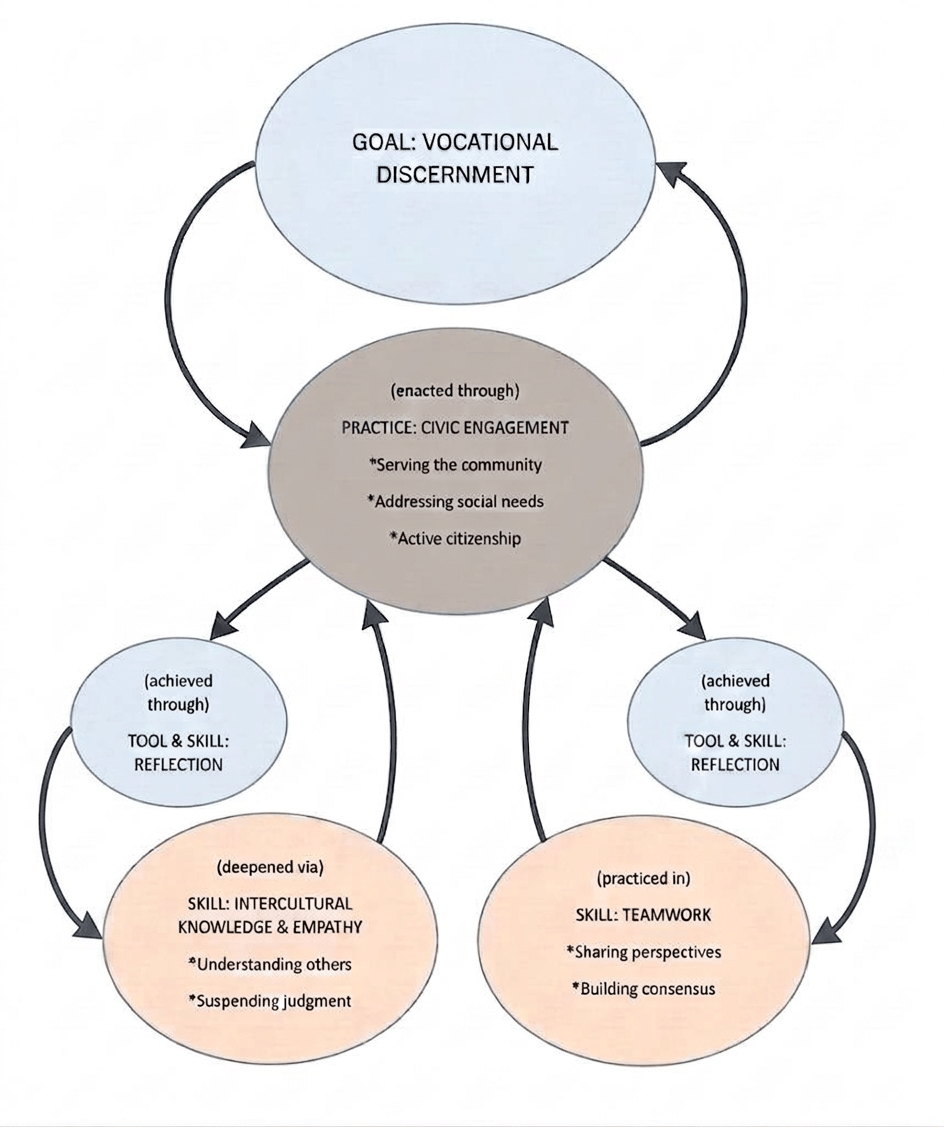
Drawing on this model, we revised the rubrics to improve the second iteration of the class and then revised the assignment to prompt more meaningful reflection on skills. Specifically, we consolidated some initial questions and added others to encourage reflection on and a deeper understanding of teamwork, intercultural competency, and reflection as vocational elements.
While the teaching project itself did not change, student papers in the second semester showed more in-depth reflection on all these skills. We wanted to promote more targeted and meaningful reflection on civic engagement—one that directly tapped into Darby Ray’s assertion that vocation requires understanding how “self and world are constituted by one another and are only and always in relationship.” This desire prompted us to add these two questions: “How do you think your teaching made a difference for the students and community at the elementary school?” and “What do you think was the community impact of your teaching?” By focusing intentionally on teamwork and intercultural competency—skills developed in their teaching project and practiced through civic engagement—we created ample space for students to reflect on their communal vocations. They did so repeatedly and from multiple perspectives, in class discussions and the sports leader interview project. We also developed more detailed rubrics to assess the subcomponents of the teamwork, intercultural competency, and reflection elements.
Unlike the prior iteration of the course, our more pointed prompts led students to demonstrate a sense of personal responsibility to serve others and to articulate their agency to make a difference in their communities through specific actions. These components were evident in a significant difference in the average rubric score in civic engagement from 2.20 to 2.85 (on a scale of 1–4). One student described that they learned “how to keep each other honest without an adult stepping in every time.” Another student wrote about the team’s intentional effort to move beyond teaching strategy, communication, and critical thinking skills in their lesson: “We also put an emphasis on having a ‘break.’ We wanted to bring the group together to reinforce a sense of play. That they don’t need to feel burned out by their sport.” Purposeful reflection questions enabled students to do more than recount their teaching experience. Sports became a window through which all students could envision well-being and teaching a vital asset for community growth.

Specific prompts—generated through our own reflective practices—laid the groundwork for students to consider their lives within relationships and communities and to develop a deeper awareness of themselves as whole people who can embrace a life of purpose in connection with others. The prompts that emerged from our model invited students to draw connections and build a framework for better understanding their own sense of calling both now and in the future. Our rubrics then helped us assess more thoroughly students’ learning in these areas. This experience reminded us that vocational reflection is not just for students: we educators also must patiently, carefully, and thoroughly reflect on our own vocations to create opportunities for students to hear the invitation to a life of contribution in connection with others.
For more information about this course and our reflection process, you can access the course syllabus and related documents through these links: Youth Sports CEL Seminar syllabus, Youth Sports Teaching CEL project, rubrics, and the diagram.
Heather Brady is professor of liberal arts at Grand View University in Des Moines, Iowa, where she teaches a community-based seminar around topics such as urban design and youth sports. Other areas of expertise include African studies, French cultural studies, and immigration. She is a NetVUE Faculty Fellow and received a 2026 NetVUE Grant to Individuals for Vocational Exploration for her research on bringing vocation to community-based learning. In 2026, she also received the Seed Coalition Award Civic Educator Award and the Grand View Award for Innovative Teaching.
Erin Olsen-Telles is a lecturer of political science and liberal arts at Grand View University, where she teaches courses in international politics, comparative politics, and immigration.
Amy S. Patterson is professor of politics and the director of the Office of Civic Engagement at Sewanee: The University of the South in Sewanee, Tennessee. She is the author of Africa and Global Health Governance and the co-author of Africa’s Urban Youth: Challenging Marginalization, Claiming Citizenship. She teaches community-engaged learning courses in politics, local development, and on semester-away programs.
For other posts in this series, go to Heather and Amy’s author pages on this blog.