

A co-authored series on what faculty members need to thrive vocationally.

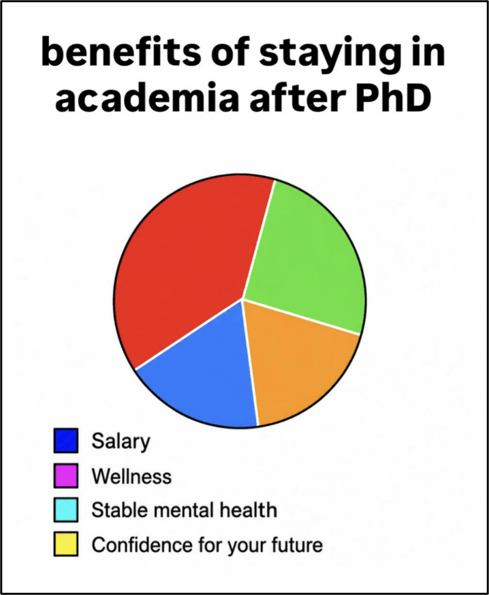
Last spring, we came across this image on Instagram (great oracle of wisdom that it is), posted by the Open Discovery Institute (ODIN), that summarized the “benefits of staying in academia after PhD.” Without putting too fine a point on it, the things that many of us might hope for (a fair salary, holistic wellbeing, good mental health, and vocational confidence in the future) were not included on the pie chart. In fact, as a close look at the chart suggests, it’s unclear what the actual benefits of remaining in higher education are. Compared to ODIN’s usual posts, which receive hundreds and sometimes a few thousand likes, this post received over 26,000. Clearly, it struck a chord.
As we conclude our series on pursuing purpose and joy as faculty members, we want to offer encouragement to our faculty colleagues in higher education, pushing back on the gallows humor that many academics, including ourselves, indulge in when we talk about our vocations. Our previous posts focused on faculty burnout, why our limitations are important, and how friendships help sustain us. Our final post reflects on cultivating purpose and joy.
Over the past year, we had the unique privilege to publish an edited volume that focused on purpose and joy as key elements of faculty thriving. Along the way, we’ve learned a lot from our colleagues. Authors in the volume explore everything from integrating teaching with research (John Anthony Dunne), to pursuing the right kinds of professional development opportunities (Robert Rhodes), to using sabbaticals wisely and carrying key practices from them into our regular faculty lives (Deborah Van Duinen). Contributors also focus on vocational discernment and significant transitions, such as moving into administration (Kimberly Battle-Walters Denu) or to a new institution (Janel Curry and Helen Sterk). Many of our colleagues reflect on how they sustained their academic through life’s twists and turns (Todd Ream, Perry Glanzer).
As we assembled these chapters, we realized that we think of purpose and joy as mutually reinforcing—essential in their differences and ultimately complementary.
For us, purpose refers to the extent to which we are intentional about our vocations. Purpose helps us create boundaries and schedule our time well. It directs us toward some kinds of research and not others. Purpose shapes our classes, guiding decisions about what to teach and why. Ideally, our purposes should fit well within our institutional contexts, adjusting as we seek to thrive within a particular place and time.
In contrast, joy refers not to what we do or how we spend our time (as purpose does), but instead to why our work matters. Joy evokes deep satisfaction and contentment, happiness and alignment with our chosen pathways and callings, and ultimately, holistic well-being.
Purpose and joy are both essential. Without joy, work is guaranteed to be a slog. If you do not like what you do or feel that it matters—or if you do not feel supported by a community that values your work—being more purposeful will not address these challenges. At the same time, without purpose, it’s hard to feel the joy that comes from doing the right work at the right time and in the right place. You might persist, but you won’t thrive. If you don’t thrive, you are unlikely to be successful in the long term.
Reorienting ourselves in this way, purpose and joy can be understood as practices, not destinations. Regardless of the locus of our callings, our professional work becomes a means and not an end; the end is finding a way to contribute to the flourishing of the world. In the work that we do as faculty members—our service and our research and teaching—we seek the good of others. While our circumstances necessarily change over time, practices of purpose and joy can sustain us.

The Human Flourishing Program, directed by Byron Johnson and Tyler VanderWeele, offers additional insight into the varied domains that contribute to our sense of purpose and joy. In a global study of over 200,000 participants, Johnson and VanderWeele define flourishing as “a state in which all aspects of a person’s life are good.” More specifically, flourishing is supported by six key domains: happiness and life satisfaction, physical and mental health, meaning and purpose, character and virtue, close social relationships, and financial and material stability. Notably, none of these are predicated on publishing a paper in a top journal or securing a grant (though those things might contribute to improvements in a particular domain).
Instead, flourishing looks a lot like finding purpose in a vocation that includes well-compensated work and accommodates other realms of our lives (including our callings). It looks like being known and loved within a community and feeling that our work matters; it includes adequate time, space, and resources to support our physical and mental health. In short, the key to purpose and joy in the academy is the same as it is across the globe and all walks of life. The cultivation of all six domains of human flourishing—both by individuals and institutions—is essential if we are to find purpose and joy in our careers.
We should acknowledge that the contexts in which we pursue purpose and joy are imperfect. There will be challenges and moments of doubt. Persistence in our pursuit of purpose and joy requires flexibility and effort. Throughout the arcs of our careers, we may find that we spend more years at an institution or in a position than we would prefer. Sometimes, living vocationally means moving to a place (or staying in it) to support a spouse or partner’s career, to provide a stable community for young children, or to care for aging parents. Sometimes, we’ll stay in a role that is burning us out for a few months too many to ensure a good transition for the next leader. Life—and people—are complicated and contradictory. But, as Janel Curry and Helen Sterk advise,
“If you decide to stay at your institution, even if the fit is not perfect, make your peace with it. Do your job and do it well. Find a way to make your institution a good home for you and others.”
We must honor the purpose in our current work with integrity, even as we acknowledge and look for ways to address challenges.

The pursuit of purpose and joy doesn’t look the same for everyone. For some, it looks like cultivating an institutional culture that attracts the right kind of people and opportunities. For others, it looks like summers spent supporting undergraduate student researchers. This diversity becomes clear even within our volume. For example, some of our authors, such as Kimberly Battle-Walters Denu, moved into careers within administration where they have found both purpose and joy. Others, like Rachael Baker, have pursued meaningful work in partnership with colleges and universities, building on skills she gained as a faculty member. Personally, we both find great purpose and joy in training future teachers. But we also recognize that our pursuits have shifted over time and that they’ll likely shift again as we continue to work within the academy.
Your college or university, and your role in it, are shaped by a mission that is (we hope) capaciously enacted. Ideally, it creates room for you to grow as a scholar, teacher, and leader, providing the necessary resources and mentorship to support you in these efforts. Time spent reflecting on your role within your institution and the opportunities it offers—and envisioning what these could be—is time well spent. Pursuing purpose and joy as complementary practices offers a framework for vocational discernment that we hope encourages thriving across the academy, urging us to consider both as we adjust their balance within and across our vocational lives.
Elisabeth Lefebvre is an associate professor of education and president of the faculty governance assembly at Bethel University in Arden Hills, Minnesota. Elisabeth’s research focuses on the mutually constitutive relationships among schooling, history, and culture. Along with Kristin VanEyk, she is the co-editor of Purpose and Joy: Pursuing a Meaningful Career in Christian Higher Education. Her research has also been published in Comparative Education Review, Journal of Education Policy, Teachers College Press, the International Journal of Educational Development, and elsewhere. She also writes about education, justice, and community for Christianity Today, Mockingbird, and Reformed Journal.
Kristin VanEyk is an assistant professor of English education at Hope College in Holland, Michigan, where she teaches writing and education courses. Along with Elisabeth Lefebvre, she is the co-editor of Purpose and Joy: Pursuing a Meaningful Career in Christian Higher Education. Her scholarship about teaching, education, and language studies has also appeared in Daedalus, Pedagogy, Christianity Today, and elsewhere.
For more posts in this series and others by Elisabeth and Kristin, please visit their author pages on this blog.
