

The first post in a co-authored series on what faculty members need to thrive vocationally.

After receiving the news that I, Elisabeth, had been awarded tenure and promoted in the spring of 2023 at age 39, I felt elated—and then, immediately burned out. Certainly, the summer before, when I submitted my application, had been arduous. My family sold and bought a house, we moved, my husband started a new job, my kids started at new schools, and we all got COVID. Then the school year seemed to fill every possible nook and cranny of time. As news of this milestone spread, colleagues asked, “How do you feel?” I answered, “I need to figure out how to do this job sustainably and with joy. Or I need to do something else.”
I, Kristin, accepted my first job as an assistant professor in 2021 when I was 37 years old, following five years of graduate school and ten years as a high school teacher. I enjoyed teaching but was ready to pursue research and writing more intentionally. By the time I turned 40, I had developed seven different courses across four programs and was serving on several committees, mostly unrelated to my research. I realized I needed to pivot and try again, or I would never reach my research goals before going up for tenure.
Perhaps you’ve felt the same as one of us—glad to have secured a position as a faculty member at a college or university (especially when they are scarce and growing scarcer) but also overwhelmed and vocationally disjointed. You’re not alone. Jeffrey L. Buller’s Retaining Your Best College Professors and research published in The Journal of Faculty Development point to the persistent headwinds faculty face, including those related to compensation, benefits, support for professional development, clarity surrounding tenure and work expectations, and frustrations related to efforts (or lack thereof) to diversify college campuses.

In fact, in writing this series, we did a search on Google Scholar for articles relating to “‘faculty attrition’ in ‘higher education’” and limited it to those published since 2020. Over 800 results were returned. Christian institutions, like the ones where we teach, are not immune from this challenge. According to Best Christian Workplaces, higher education scores the lowest of all surveyed sectors; it is also the only sector with an average score that falls into the “unhealthy” engagement range.
Within our contexts, the answer to the challenge of faculty thriving (or failure to thrive, as it were) is often suggested to be a deeper understanding of vocation. Many times, we have heard Frederick Buechner’s definition of vocation: “the place where your deep gladness and the world’s deep hunger meet.” Superficially, this seems to suggest that we should be happy if our work contributes to the world. This definition echoes popular clichés like, “find a job you love, and you’ll never work a day in your life.” Yet Buechner’s thinking is more nuanced. “Neither the hair shirt nor the soft berth will do,” he writes. In other words, pursuing vocational thriving is complex and ever-changing, and might be—or even should be—neither completely comfortable nor uncomfortable.
Karen Swallow Prior articulates well the tensions we often feel related to our work. “A job isn’t just a source of income,” she writes, “but can be seen as a way to fulfill a greater purpose. A general greater purpose, however, may not be (or at least may not feel like) your own greater purpose.” In other words, the fact that work fulfills some purpose will not by itself bring joy. “Finding work that aligns with our passions, desires, and gifts,” she observes, “is, of course, ideal. It just doesn’t always happen, and that is okay. It doesn’t mean there is something wrong with you.”
We have both come to realize that as we pursue our callings within higher education, our work has the potential to contribute to the world—whether we are doing research in a lab, discussing a work of fiction in a literature class, meeting a student for coffee or lunch, supervising a pre-service teacher in the classroom, or even submitting a well-written accreditation report. But if the work we do doesn’t bring us joy—if instead it only leaves us feeling “bored and depressed,” in Buechner’s words—then it may indicate that something in our vocational pursuit is unfocused or unbalanced.

If you are feeling bored or depressed by aspects of your work, or if you wish you could replace parts of your job with different responsibilities, then this more nuanced view of vocation is good news. It might mean your calling has changed or is changing, or that you haven’t found the right way to do the right work with the right people, or that you’ve not yet found the right space in which do that work. Maybe you lack adequate support, or perhaps your job is just a job that supports you as you live out callings beyond paid work, as Turner Smith notes in our edited volume. To quote You’ve Got Mail, it can be helpful to think of vocation as a project that needs “tweaking”—both internally (What can I personally do differently?) and externally (How might we as a village change various structures to support thriving?).
It can be helpful to think of vocation as a project that needs “tweaking”—both internally (What can I personally do differently?) and externally (How might we as a village change various structures to support thriving?).
Here’s the important thing: if faculty members are to support students in discerning and pursuing their vocations sustainably, then they themselves must do the same. Thoughtful and effective vocational mentorship stems from the development of those self-same skills. It’s good practice for us to continuously reflect on our own vocational fit—on how eager and equipped we are to do our work, on how we understand our work as mattering for ourselves and others, on how our work enlivens our imaginations to better our understanding of and contributions to the life of the world, and on the question of whether our institutions are equipped to support us in doing those things.
These are not ethereal commitments dreamed up in ivory towers. Whether viewed from a Christian perspective (as we and many of our colleagues do) or not, our callings are material and consequential. And feelings of boredom or discontent can be a sign that we need to pursue something different, or at least differently. Fundamentally, we believe it is essential to ask ourselves: How do we pursue such a vocational mindset with purpose and joy?
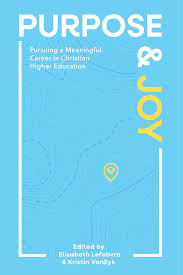
In the following series, we focus on three key themes that emerged from our recently published edited collection, Purpose and Joy: Pursuing a Meaningful Career in Christian Higher Education. Drawing on insights from the 27 authors who contributed to the volume, as well as engaging research and conversation by and from faculty members across the academy, we highlight three foundational principles we think are essential to thriving as faculty members:
- You have limits and they’re good. Limits help us discern what is and what is not part of our callings.
- You really do need a village. Despite the pervasive myth of the solitary life of the mind, scholastic resilience necessitates deep community.
- Pursuing joy requires persistence and intention. Joy isn’t a place or position that we stumble across so much as it is a practice or skill that we can cultivate.
Writing primarily from our perspective as faculty members, and as editors of this volume, we suggest habits that faculty members can implement as they pursue purpose and joy in their careers. Many of these insights are also applicable to others working in higher education, including staff members who might face similar questions related to their vocations or academic leaders seeking to understand and support faculty members and staff. Our purpose is to invite a collaborative conversation that contributes to faculty thriving.
Ultimately, if faculty members—and our colleges and universities—are to succeed, we need not only to recognize our limits, build community, and practice joy, but also to cultivate cultural and institutional patterns that support this work.
Elisabeth Lefebvre is an associate professor of education and president of the faculty governance assembly at Bethel University in Arden Hills, Minnesota. Elisabeth’s research focuses on the mutually constitutive relationships among schooling, history, and culture. Along with Kristin VanEyk, she is the co-editor of Purpose and Joy: Pursuing a Meaningful Career in Christian Higher Education. Her research has also been published in Comparative Education Review, Journal of Education Policy, Teachers College Press, the International Journal of Educational Development, and elsewhere. She also writes about education, justice, and community for Christianity Today, Mockingbird, and Reformed Journal.
Kristin VanEyk is an assistant professor of English education at Hope College in Holland, Michigan, where she teaches writing and education courses. Along with Elisabeth Lefebvre, she is the co-editor of Purpose and Joy: Pursuing a Meaningful Career in Christian Higher Education. Her scholarship about teaching, education, and language studies has also appeared in Daedalus, Pedagogy, Christianity Today, and elsewhere.
For more posts in this series and others by Elisabeth and Kristin, please visit their author pages on this blog.