

A series on vocation, the dignity of labor, and the misconceptions that prevent us from valuing all work.

My favorite show of all time is The West Wing, and the evidence of that love is everywhere. Questions from the series adorn my computer at work. I have Toby’s rubber brainstorming ball in my office. I devoured podcasts about the show years after it went off the air. I’ve bought my wife West Wing gifts, as she has for me. And it’s possible that two of my kids were named after characters from the show (okay, that was a coincidence). The most famous line from the show is probably the oft-repeated phrase, “What’s next?” These words are President Bartlet’s motto as he navigates his days in the Oval Office—his way of saying that the present task is done, and it is time to turn our attention to other matters. I love its crisp, clear, directional tone and the way he uses this phrase to lead his team through their shared work together. As I’ve watched the series over and over, these words have wormed their way into my lexicon as well. I’m guessing my fellow West Wing fans can relate!
There is another way of asking that question, though, that is less helpful, particularly for those of us who work in the field of vocation. I remember when my son—who is about to start college this fall—was in the eighth grade and visited a local high school. The guidance counselor, not surprisingly, asked him what kind of college he hoped to get into one day. He rattled off an answer and the counselor responded that if he wanted to get into that college, he would have to test out of freshman level math that day, as an eighth grader. It was disheartening to see the way a middle-school student tied his college hopes to the outcome of an exam he had to take at age 14. This exam created an overwhelming amount of undue stress. In his mind, it carried the fortunes not of his next step of high school, but his next-next step.
It also caused him to fixate on the future to the detriment of the present. As we navigated high school over the last four years, I noticed not just his preoccupation with the next thing, but also that of all the high school students in my orbit. Like President Bartlet, these students were asking, “What’s next?” but unlike President Bartlet, they were asking it long before they finished the current phase of life they were navigating, and they were asking it in every arena of their lives—academics, athletics, and relationships.
I’ve also noticed this preoccupation in my undergraduate students. So many of them enter college with their eyes already set on the next step, whether it be graduate school or a big-time job offer. Their focus on their futures feels different than goal setting and healthy aspiration. These students view their “present” instrumentally, as a rung that must be climbed toward some unrealized future, and express a kind of cultivated dissatisfaction with their current situation because “the next thing” is really the prize.
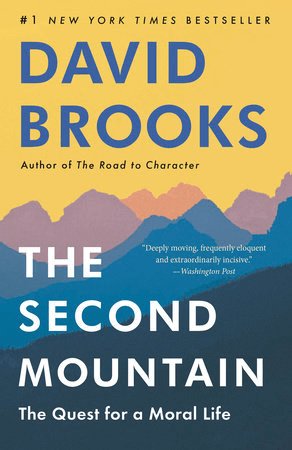
I’ve been wrestling with the symptoms of this “What’s next?” syndrome and trying to figure out what causes it. David Brooks observes that many students are ultra-pragmatic. By carefully planning and securing their next steps (well in advance!), he writes, they can feel that “the uncertainty is over,” for “now they will have a good answer when adults ask them, as they are prone to do, what they are going to do after graduation.” Students are attracted to this way of living, he believes, “to keep the existential anxiety about what to do with their life carefully suppressed underneath the waterline of consciousness.”
Brooks’s insights suggest that adopting these pragmatic life-planning strategies could very well be ways of masking existential anxiety. Brooks wonders if young people do so because they are substituting the “what to do” questions for “why I do it” ones. If he’s right, it makes sense. There is a deep and abiding desire in each of us to flourish in our lives and to do work that has meaning for us personally and that matters in the world. Such desire, though, brings with it a worry (based on some manner of accounting) that our work won’t matter as much as we want it to. It’s quite possible that the unhealthiest versions of careerism, upward mobility, and life-design seminars give space for students to predetermine all their “What’s next?” steps to avoid living with the anxiety that they might not have “made it” in ways that matter to them. It creates a commune of “insecure overachievers” who are “never fully satisfied.” My hypothesis is that any young person (17-22) with a rock solid 10-year plan is probably wrestling to keep that existential dissatisfaction at bay.
Writing about the dignity of labor in my forthcoming book helped me see that when this perpetual dissatisfaction pairs with, or is amplified by, achievement culture, it makes it very difficult to affirm the value of work. If my current job is just a weigh station toward my eventual destination, then its value is only instrumental. If “What’s next?” is what I really want, then I cannot truly affirm the value of what’s now. This dynamic feeds into the comparison and competitive cultures I’ve also explored and fosters an unhealthy expression of ambition that resists the virtue of contentment essential for cultivating the good life.
Contentment is not complacency, an embrace of mediocrity, or an admonition to “accept one’s lot.” Instead, it’s an invitation to resist the striving that characterizes so many people’s lives today—so much striving, but to what end? Contentment allows a healthier version of aspiration to grow. It is a different way of thinking about our current station that does not implicitly demean “ordinary” workers and the “ordinary” work we all do daily.

Still, the implications for the work of vocation in higher education are significant, and they challenge me in ways I had not fully previously considered. How should my work change if I want to help students imagine a life of contribution to the common good—one that resists the dissatisfaction common to so many who have not yet achieved what they envision for their lives? How should I help students think about their futures without reinforcing a “What’s next?” mentality that makes them less able to appreciate their present lives and the places they inhabit?
This problem is not just one for students. I see so many people expressing discontent with their work in a way that leads them to actively disparage the labor of others. It might seem counterintuitive, but a fuller embrace of the dignity of all those who labor in our communities might help us cultivate healthy contentment in the places we ourselves live and work.
As I’ve acknowledged throughout this series, integrating a real commitment to the dignity of labor gives us a vision for how we might engage the work of vocation more humanely—in ways that don’t subtly reinforce the social hierarchies and cultural stories that work against our students’ flourishing throughout their lives. I’m even more energized and motivated to navigate the waters of this work here at my institution; I hope you are as well.
Adam Gustine is an associate director at the University of Notre Dame’s Institute for Ethics and the Common Good, where he directs the program in virtue ethics, education, and formation. He has worked in a variety of faith-based and denominational leadership contexts within higher education. He is the author of Becoming a Just Church: Cultivating Communities of God’s Shalom and co-author of Ecosystems of Jubilee: Economic Ethics for the Neighborhood. His newest book, A Working Theology of Labor: Justice, Dignity, and the Common Good (Baker Academic) comes out in October 2026. For more posts by Adam, click here.