

A series drawing on a therapist’s insights into play, wandering, and presence in relation to vocational exploration and discernment.
In the first post of my series, I offered a method of reviewing your childhood self at play as a way to provide insight into your being-role, an aspect of yourself that is necessary to cultivate to flourish vocationally. This approach could suggest incorrectly that vocational exploration is primarily inward focused and solitary. But vocational understanding requires more than introspection. From our earliest moments, self-understanding emerges in relationships with others whom we trust and who can clarify strengths or needs that develop latent attributes within us. Exploring vocation requires both inward and “other-ward” attention.

In this post, I offer a reminder that we are never simply an “I” unto ourselves. U.S. culture—especially in academic contexts—heavily skews toward individualistic notions of the self, yet there is always a “we” in any “me.” Many of our collective networks speak powerfully to our identities and the manifest forms of our vocations if given the opportunity. Social psychology posits that in any one individual there are many varied selves dependent on the social environment. The self that you reveal to your family at home around the dinner table is notably different from the one you present at a professional conference. Both are authentically you, but specific aspects of the self are more dominant in each environment. Often different aspects of ourselves may be more visible in a particular social context and therefore may be witnessed more directly by those in our life and somewhat obscure from our own recognition.
Although you, as a self, possess the foremost knowledge of yourself, we can also be blind to how others perceive aspects of ourselves, which our social groups can illuminate. Return to the version of yourself at dinnertime and contrast it to the you at the professional conference. If your partner weighed in on your most visible aspects, what attributes might be revealed? Conversely, if a colleague at the conference described you, how would this description be similar or different to your own or your partner’s perceptions?
The Johari window is a perception tool that takes up these kinds of questions and can be used to gain a more robust view of yourself. Developed in 1955 by psychologists Joseph Luft and Harry Ingham, it lays out a quadrant model of self-awareness. Typically, in social organizations a list of adjectives (mostly positive) is given to each member. They identify five words that describe themselves and then five to describe another group member. Then each descriptive list is sorted through the framework below. If I think “dedicated” describes me, and a trusted group member also selects this word to describe me, then this aspect falls into the arena quadrant, representing a part of myself that is open and known to myself and others. If I choose “creative,” but my colleague does not include this descriptor in the five words they choose for me, then this quality falls into the mask category, representing a private aspect of myself. If a trusted other chooses “brave” to describe me, but this word is not one I choose, then this aspect of myself is considered a blind spot.
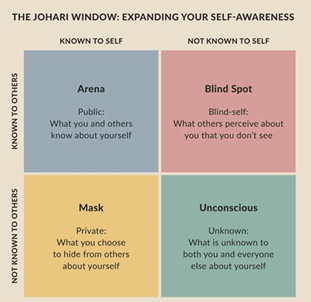
Curiosity about each of these quadrants allows us to reflect more deeply on our vocations and callings. The more visible and immediate implications of this activity may be obvious, but the deeper motivations underneath these activities are often less apparent, even to us. To illustrate how we might reflect more fully on possible results that fall into the public quadrant, imagine you have a 26.2 sticker on your car’s tailgate, which serves as a visible indicator about you: You are a runner, and you value the time and energy you invest in running. Now here’s where this tool becomes more revealing. Why did you become a runner? Is it for the sense of peace you get at mile marker 15 or for the satisfaction you gain from besting your previous time? Or are there other reasons that motivated you to become a runner? Which one is the most compelling to you? Be mindful that this motivation could be known to others—that is, you share the runner’s high that you experience freely with your friends and family—or it could fall into the private quadrant—not known to others or even unconscious and not even known to yourself.
Both the unconscious quadrant and the private quadrant offer rich material for vocational exploration. Psychological studies have found that the most useful way to shift blind spots to known areas for development is to actively seek and then consider others’ feedback. This task can feel daunting, especially if the feedback is given in a punitive or malicious way. But in the right context, others can be quite generous and notice recurring strengths, relational habits, values, or ways of being that are so natural for us that we may overlook their existence or question their value. When several trusted people independently identify similar qualities, these themes provide a more holistic understanding of our own unique proclivities. In the traditional Johari window exercise, there is typically a pre-determined list of mostly positive attributes given for each group member that is compiled. However, for those seeking to grow in their self-perception, asking trusted others open-ended questions that identify four to five being-roles, attributes, or aspects of you can yield rich content.
I have found this exercise useful with students in general psychology and “college 101” courses, where the content lends itself to understanding human nature and vocational exploration through intentional self-reflection. I typically ask students to first describe themselves, and then I and a classmate will list visible aspects of who they seem to be, which then sparks vocational conversations. For example, when a student was described as adaptive—he was calm under pressure—it elicited further conversation of how this quality could be important for him in his future. Other professional strengths like natural leadership—which personal insecurities kept him from seeing—also held significant vocational insight. In these ways, the Johari window is a useful tool that initiates conversation about how the self contains different parts, some of which are only visible to others and can be further developed once named and internalized.

In the context of our vocations and callings, the I/we dichotomy is not a problem to solve but a productive tension to navigate and to balance. Yet hearing others’ perception can create additional challenges. If vocational exploration requires us to seek out and listen to trusted others, how do we avoid becoming defined by their expectations? To navigate this tension, family systems theorist Murray Bowen identifies the balancing process as a differentiation of the self: having a sense of what is mine and unique while also maintaining a connection to what is ours and shared. Bowen describes individuals with low differentiation as typically overburdened and prone to burnout, as they carry expectations of the group, their family, or the workplace and their need for approval too strongly. On the other hand, the solitary nature of our Western sense of self can create disconnection and isolation from the very relationships that offer meaning and purpose. To help us balance these impulses, we often need to see ourselves more fully, and using the Johari window in our professional roles can be illuminating, as it can in our work with students who are beginning the lifelong pursuit to understand their own gifts, values, and motivations. Trusted loved ones, mentors, colleagues, and communities often perceive strengths, patterns, and possibilities that we cannot readily see ourselves.
The I/we integration necessary to explore the vocational questions of “Who am I?” and “How do I contribute?” is an individual and communal undertaking. Exploring both impulses, even when they are in tension, enriches the possibilities for self-understanding. Vocational discernment requires both differentiation and connection for a clear sense of self. Vocation is never solitary; callings need a self that is reflective enough to choose curiosity and connected enough to care for the common good.
Carrie Caudill is an associate professor of psychology at Newberry College and a licensed therapist. Her work integrates mindfulness, nature, spirituality, and relational well-being to promote human flourishing across educational, clinical, and community settings. Her scholarship and professional presentations focus on mindfulness, nature-based interventions, spirituality, mental health, relational quality, and their impact on well-being. Her writing has appeared on Psychology Today and the South Carolina Counseling Association’s blog, as well as in the journal, Mental Health, Religion & Culture. She was a participant in the 2026 NetVUE Writing Colloquy. For more posts by Carrie, please visit her author page on this blog.