

A conversation with Norman Wirzba that is part of a series of reflections on his book Love’s Braided Dance: Hope in a Time of Crisis and NetVUE’s 2026–2027 Big Read program.

In a time of crisis, the question—“What gives you hope?”—is, for Norman Wirzba, the wrong question to ask, for he argues that hope is not something that we can possess. Instead, he wonders,
“What if hope is … a loving way of being that is animated by an affirmation of the goodness of this life, a practiced way of life rooted in the conviction that this life is worth cherishing, defending, and celebrating?”
Accordingly, he believes that we should shift the question from “What gives you hope?” to “What do you love?” and “How does this love change what you hope for?”
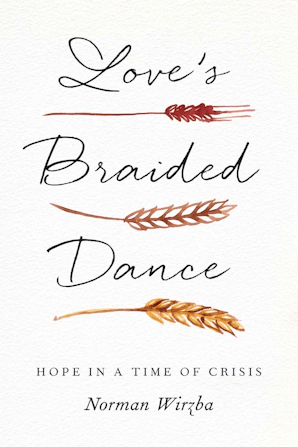
These questions frame his most recent book, Love’s Braided Dance: Hope in a Time of Crisis, which NetVUE has selected as its Big Read for this academic year. This program offers faculty members, staff, and administrators at NetVUE institutions the chance to join a network-wide conversation about vocation, using the selected book to anchor their discussion.
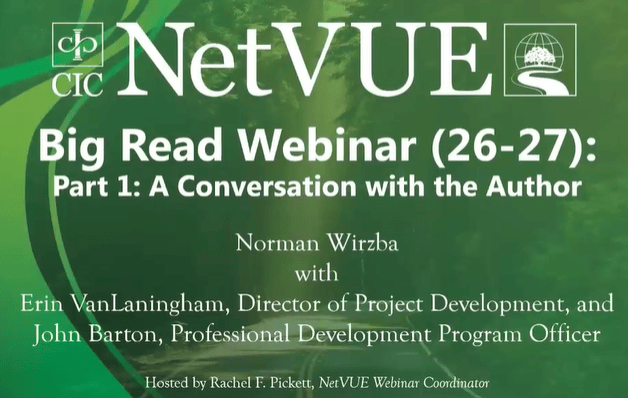
To support these efforts, NetVUE has programmed a three-part webinar series that provides participants in the program with ways to think about the book and resources they might use to support their campus conversations. On September 16, NetVUE hosted the first webinar of this series—“A Conversation with the Author”—in which NetVUE staff members Erin VanLaningham and John Barton interviewed Wirzba and explored some of the book’s context, framing, and major themes.
The title of Love’s Braided Dance is drawn from a poem by Wendell Berry, “In Rain,” which meditates on the discerning of a path, people’s connection to the earth, and the generations it has sustained. As the speaker of the poem observes (and Wirzba cites in the book’s introduction),
The way I go is
marriage to this place,
grace beyond chance
love’s braided dance
covering the world.
These lines point to one of Wirzba’s central preoccupations in the book: a vocational commitment to the places we inhabit and our interconnected movement through the world.
In the webinar, Erin VanLaningham asked Wirzba to reflect on the significance of these kinds of commitments and on Berry’s influence on Wirzba. Berry was both guide and friend to Wirzba, whom he remembers for the kindness, hospitality, and generosity that the Kentucky writer offered him. So much of Berry’s writing—including his poetry, fiction, and essays—resonates with Love’s Braided Dance, but The Country of Marriage, a short cycle of poems, “speaks directly to the themes” of the book. Wirzba also recommended Hannah Coulter for the ways it describes her community’s “successes and failures over the generations.” Such “fiction,” Wirzba said,
“is so very valuable for understanding the themes of Love’s Braided Dance because one of the things I wanted to do in [it] was adopt more of a narrative style, because hope is something you live into … You really need to have stories to do that … You have to find ways to make the concepts live and fiction is a great medium for doing that. It helps you understand when hope is active and why it’s active, and also when hope is languishing and why it’s languishing. So stories are a great way to get into some of the themes that are in the book.”
As this part of the webinar suggests, readers who are looking for additional context and ways to frame their engagement with Love’s Braided Dance might find “In Rain” and these other literary texts useful. Viewing the webinar and seeing and hearing Wirzba make these connections directly is even more powerful.
The webinar also focused its attention on Wirzba’s purpose in writing a book about hope, especially as it aspires to engage younger readers. As John Barton noted, in the book’s second chapter, Wirzba acknowledges the very real challenges that young people face and the ways that these challenges inhibit their ability to imagine and hope for a generative future. “A growing number of young people,” Wirzba writes, “feel that their leaders do not care much about the world they and the next generations will inherit. Accordingly, they report that they are seriously contemplating, and sometimes deciding, not to have children.”
When asked to elaborate on the significance of these challenges and how educators might guide undergraduate students through them (or prepare them to face them), Wirzba responded by acknowledging that young people are deeply suspicious of hope and rightly so. They don’t think that the world will be okay, and they resent it when their teachers and mentors tell them—especially in superficially optimistic ways—that it will be.
But Wirzba argued, “Hope and optimism are not the same thing.” In his mind, optimism allows us to view our current systems as better than they are and to believe that we can work productively within them. Yet Wirzba admitted, “I don’t think the systems are good,” nor do many young people. Their teachers and mentors must be “honest with the challenges we’re facing” and “acknowledge their deep suspicion and at the same time, recognize that hope is one of those fundamental words that we need to have in our grammar,” even if this concept can be misused and used to control others.
“We have to recover,” Wirzba contends, “the meanings of these words and why they matter for the living of a good life.” If educators abandon the language of hope, then he fears the loss of something essential for our humanity. But as we reclaim this language, we “need to do it in a way that is listening to young people who’ve got legitimate suspicion” of how we’ve used this term.

Ultimately, Wirzba believes that educators must listen deeply to young people even as they continue to encourage them to mobilize hope and actively pursue it as they navigate the challenges of the world (and their education). He doesn’t want to force anyone to embrace this way of being and acting in the world, but he does aspire to “show how hope would be operative in lots of different spheres, maybe even in surprising ways.” In this way, Wirzba seeks to expand readers’ understanding of hope and inspire them to take meaningful action in affirming what they love.
Even though Love’s Braided Dance is rooted in Christian theology, it also reflects Wirzba’s humanist desire for a broader communal exchange and his own skepticism of certain religious notions of hope that view God as the fixer of all our problems. The book might feature a theologically informed grammar of hope, yet it offers a way of thinking about hope that is available to everyone. According to Wirzba,
“The questions that hope addresses are questions that are available to everyone—and urgent I would say, for everyone—because the question of hope is addressing the fundamental question about what is the point of your life? And that’s a question that everybody needs to ask whether they are in a particular faith tradition or not.”
This vocational question is what makes this book such a compelling addition to NetVUE’s collective conversation about calling. And the rest of the webinar offers any number of insights into possible ways to answer it, including Wirzba’s reflections on the importance of “life together,” erotic hope, forgiveness, dance, and improvisation. NetVUE members looking for additional guidance for how they might frame the Big Read programming on their campuses will find much to value in this webinar.
The webinar was recorded and can be accessed (along with additional resources) through NetVUE’s webinar page, which includes links to which all faculty and staff members at NetVUE institutions have access. For more information about NetVUE’s Big Read program and resources that support it on member campuses, go to the Big Read website. Interested in becoming an institutional member? You can find more information on NetVUE’s website for membership.
Geoffrey W. Bateman is the editor of Vocation Matters and NetVUE’s director of strategic communications. In 2017, he participated in the inaugural NetVUE faculty seminar on Teaching Vocational Exploration, and his essay, “Queer Vocation and the Common Good,” appears in the fourth volume of the NetVUE Scholarly Resources Project, Called Beyond Our Selves: Vocation and the Common Good (Oxford, 2024). He contributed “Queer Callings: LGBTQ Literature and Vocation” to Cultivating Vocation in Literary Studies (Edinburgh, 2022), and is a professor of criminology, sociology and justice studies at Regis University. Visit his author page on this blog for other posts by him.