Wendell Berry, who died at 92, was a profound thinker advocating for a redefined understanding of work, economy, and personal calling. His insights emphasize the importance of affection and meaningful engagement with community, arguing that true fulfillment comes from vocation rather than societal definitions of success. His legacy urges individuals to live with purpose and care.
When Wendell Berry died at the age of 92 on August 31, TheNew York Times headline called him a “Writer Who Extolled America’s Agrarian Past,” which doesn’t exactly scream relevance for those of us helping young people discern their present and future vocations. A better headline might have mentioned that Berry was a thinker who urged us to reimagine conventional ideas of work, economy, and success, and to remember the role of affection in discerning and living out our human callings.
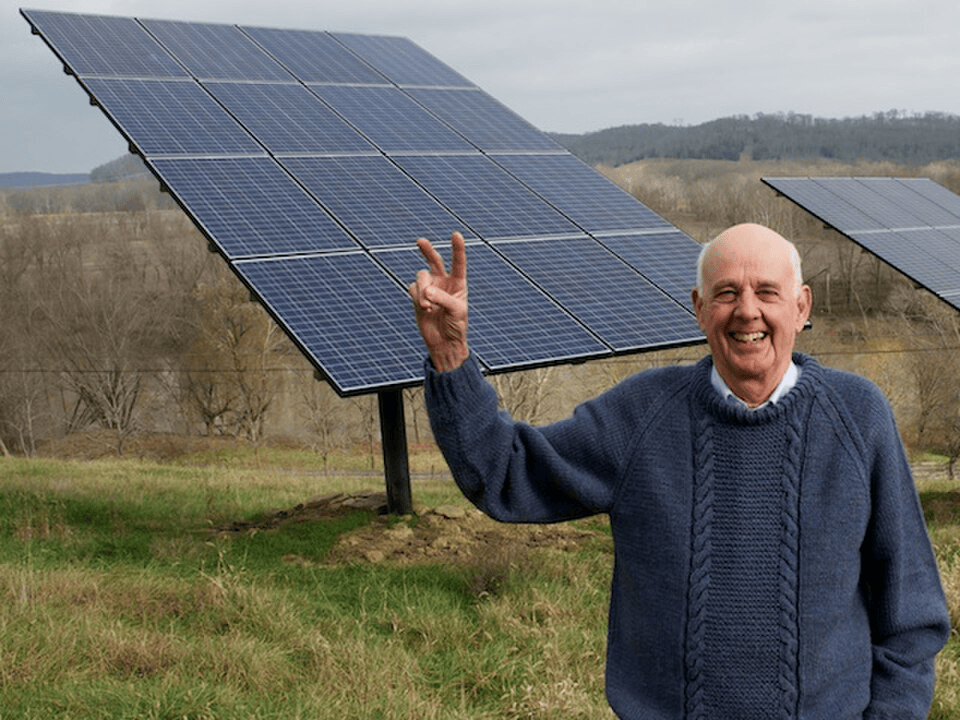
Wendell Berry stands before the solar panels on his farm in Henry County, Kentucky. Photo by Guy Mendes, 2011.
Wendell Berry critiques competition-driven economic systems, particularly in U.S. agriculture, arguing they diminish communal bonds and promote self-centered ambitions. Higher education perpetuates this by encouraging students to view success as individualistic. Instead, fostering a sense of contribution to the community can reshape students’ sense of vocation and enrich societal collaboration.
A series on vocation, the dignity of labor, and the misconceptions that prevent us from valuing all work.
In “Economy and Pleasure,” Wendell Berry writes, “No individual can lead a good or a satisfying life under the rule of competition … no community can succeed except by limiting somehow the competitiveness of its members.” This impulse to compete, Berry argues, drives our economic system, which divides people into two categories: winners and losers. His particular focus in this essay is on agriculture in the United States, where he sees such competition as the dominant mentality: farmers race to acquire the education and resources necessary to defeat other farmers in a game governed by “the rules of competitive economics.”
To consider education as gift, above and beyond what one might pay for it, changes the way that we reflect on and carry out the work for which education prepares us.
When my oldest son was in elementary school, he would quite innocently announce that he was in the “gifted and talented” program at his school. His mom and I would wince. Would others take his proclamation to be the self-deserving swagger of a 10-year-old white kid? He is now on the college admissions circuit. Have we parents, teachers, coaches, and pastors enabled him to see and resist wielding his white, male privilege? And, if so, could he nonetheless hold onto his 10-year-old self-understanding that he (and you and I) are, indeed, gifted and talented—quite literally the recipients of gifts and the stewards of talents that we did not earn but that we are called to develop and use for the flourishing of whole communities?
My recent posts have circled around this notion of giftedness and being gifted. I’ve suggested that the circulation of gifts is a more helpful way to describe being educated for vocation than what often passes for purpose and meaning within higher education. This is largely because education, in both private and public settings, has been made into an investment seeking return and a product to be purchased. To consider education as gift, above and beyond what one might pay for it, changes the way that we reflect on and carry out the work for which education prepares us. I want to bring some of these musing together here and consider how understanding students as gifted and education as a gift economy can lead to restorative and regenerative work.
Since we cannot escape our interdependence and interconnectedness, we are forced to confront our life together as kin (or “oddkin,” as Harraway says). To re-configure our relations, we must unmake, make, and remake; we must indulge in the work of imaginating, speculating, and fabulating a future for all creatures and life forms. This is not fantasy, but justice.
A series of posts about a collaborative project at Wingate University, resulting in a first-year course called Food and Faith: Health and Happiness Around the Many Tables of Our Lives.
This third blog in our series will explore how our pedagogy reflects our belief in Earth’s entangled banks as a source of wisdom. We model our course design and teaching on our belief that we are all interdependent beings living in webs of relations and education for vocation is a co-creative process. We thrive when we live and learn by re-membering these elements of our identities as individuals and societies. This post will focus on our nature as co-creative creatures and how to teach with co-creativity as a guiding principle.
One of the key skills needed for vocational discernment is the ability to know who or what one is besides being just a consumer.
Counterpoint Press, 2019
Over the last couple of months I have been slowly savoring Wendell Berry’s latest collection of essays and short fiction, The Art of Loading Brush. Many of us who think carefully about vocation and teaching vocational discernment love Berry’s writing, and this collection reminded me why. He explicitly discusses vocation in the context of creating life-giving local economies, and in thinking through his argument I found a useful way of talking to students about vocation: making a distinction between being a consumer and being a producer, and the value of thinking of oneself as something more than just a consumer.
From Look and See, documentary on Wendell Berry (2016)
I am afraid that some amount of doubt may have crept into this project since my last post on Wendell Berry and his definition of community. My argument in that post was simple: it would be good if professionals, and those who train them, might spend at least a few moments thinking through the implications of Berry’s ideal community along with his critique on modernity — both are described in his 1969 essay, “The loss of the future.”
The doubt crept in after I took my own advice and re-read Berry’s 2014 essay, “Our deserted country,” which can be found in the 2015 collection entitled Our Only World.
The essay contains the following definition of vocation:
The idea of vocation attaches to work a cluster of other ideas, including devotion, skill, pride, pleasure, the good stewardship of means and materials. Here we have returned to intangibles of economic value. When they are subtracted, what remains is “a job,” always implying that work is something good only to escape: “Thank God it’s Friday.”
One definition of “community” that I have become fond of lately comes from a quote by Wendell Berry. You don’t have to look very hard for a good quote by Wendell Berry about almost anything. I could get lost on Berry’s BrainyQuote page and never find my way out. The connection between vocation and community is strong throughout Berry’s work, but David Guthrie’s recent post, which highlights the many shortcomings of our academic communities, has convinced me that Berry has something important to say about this connection. My plan is to look at two of Berry’s essays, the first (in this post) published in 1969 and the second (next time) published in 2015, that contain definitions of community and vocation that may very well be… definitive. Continue reading “(Re)-reading Wendell Berry on community and vocation (part 1)”