NetVUE’s February 2024 Webinar focused on vocational elements of education and personal development outside of typical educational settings.
Engaging students in the classroom continues to be an essential part of undergraduate education. But what if we took our work outside the typical classroom? To reach a those students who may not have easy access to education, we must become creative and meet them where they are. Opportunities to explore meaning and purpose should be accessible to all.
NetVUE’s February 2024 Webinar focused on vocational elements of education and personal development outside of typical educational settings. On February 7, three invited speakers discussed experiences of and strategies for taking vocation beyond the traditional campus in our work with students from diverse backgrounds.
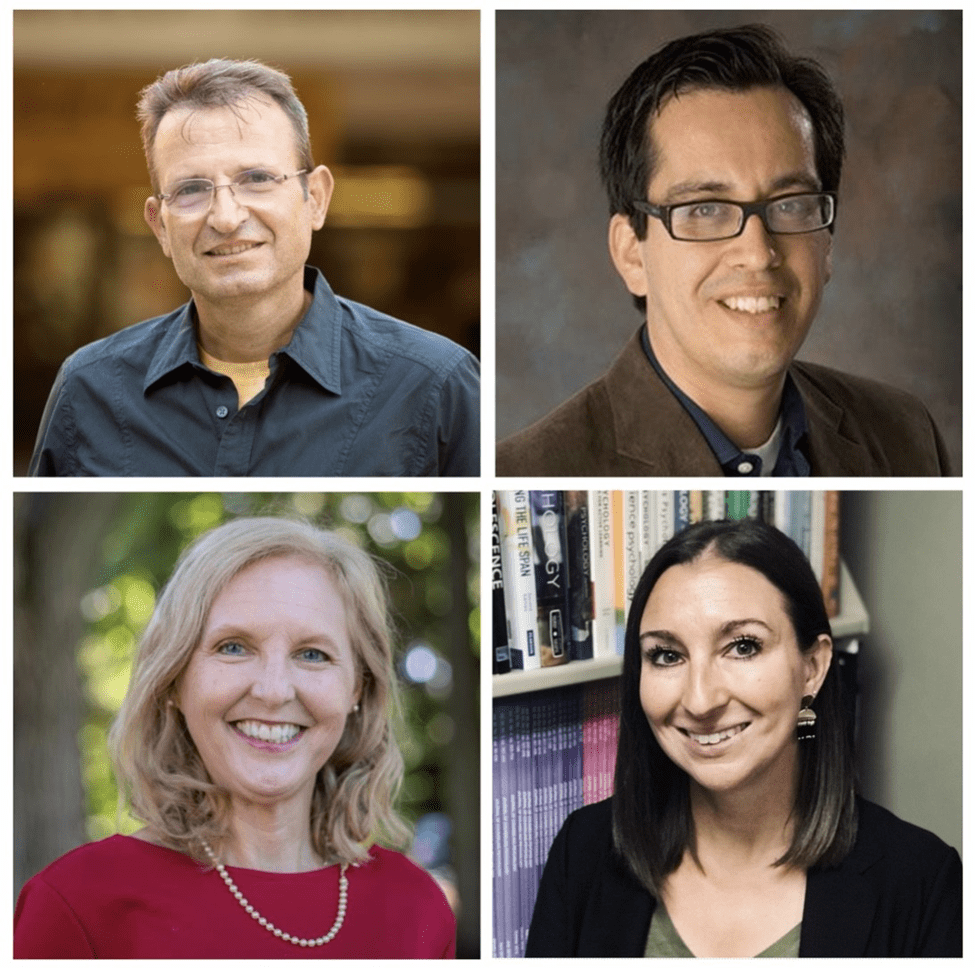
Heather Brady (top left), Jason Mahn (top right) Jason Stevens (bottom left), Rachel Pickett (bottom right)
NetVUE’s November 2023 Webinar focused on vocational elements of peacemaking and conflict resolution in the context of existing conflict and violence in various parts of the world, such as Gaza and Ukraine.
Engaging students in the classroom continues to be an essential part of undergraduate education but is often a challenging task. Current world events can be complicated, stressful, and difficult to understand. NetVUE’s November 2023 Webinar focused on vocational elements of peacemaking and conflict resolution in the context of existing conflict and violence in various parts of the world, such as Gaza and Ukraine. Exploring meaning and purpose as peacemakers can help students connect academic topics as well as personal development to global and local realities. On November 21, three speakers discussed experiences and strategies for how we can integrate global events in our work with students.
John Barton (top left); Geoffrey Bateman (top right); Jonathan Golden (bottom left); Rachel Pickett (bottom right)
On September 26, 2023, NetVUE hosted a webinar focused on vocational elements in current films. Four speakers discussed their experiences using film and provided strategies for integrating movies in our work with students.
Engaging students in the classroom continues to be an essential yet challenging part of undergraduate education. Popular culture can provide an additional avenue for connection. Exploring meaning and purpose can be a creative and effective way to bring contemporary media into the classroom. On September 26, 2023, NetVUE hosted a webinar focused on vocational elements in current films. Four speakers discussed their experiences using film and provided strategies for integrating movies in our work with students.
Antonios Finitsis (upper left); Marie Drews (upper right); Martin Dotterweich (lower left); Brian Bowman (lower right)
As part of its 2023 UnConference, NetVUE hosted a webinar on March 23 with three teams who discussed their experiences and strategies for actively integrating vocation into diverse populations so that both our students and our communities benefit.
As our society continues to become more diverse and connected to the global community, students need to consider their vocations in a sociocultural context. In addition to helping students discern their many callings in life, this work can make an important contribution to developing campuses and communities that are more diverse, equitable, inclusive, and just. As part of its 2023 UnConference, NetVUE hosted a webinar on March 23 with three teams who discussed their experiences and strategies for actively integrating vocation into diverse populations so that both our students and our communities benefit.
From left to right: John DeCostanza, Sheila Bauer-Gatsos, Bradley Pardue, and Trishia Kholodenko.
NetVUE’s Spring 2023 webinar on February 7 focused on vocational narratives as a creative and effective way to find meaning in challenging times.
As students continue to navigate ever-changing, demanding times in higher education and the world, feeling a sense of purpose and control over one’s life is important. NetVUE’s Spring 2023 webinar on February 7 focused on vocational narratives as a creative and effective way to find meaning in challenging times. The webinar featured three speakers who discussed their experiences and strategies for integrating vocational narratives in our work with students.
NetVUE’s Fall 2022 Webinar focused on “Vocational Discernment as a Wellness Tool” and featured Elizabeth Kubek and Debra Minsky-Kelly
Campus life is gradually beginning to return to a new normal after two years of pandemic learning. Students are back in classrooms, and co-curricular activities are in full swing. However, there is still much healing and readjustment to do since the psychological impact of the COVID19 pandemic will be with us for years to come.
To address this new normal, NetVUE’s Fall 2022 Webinar focused on “Vocational Discernment as a Wellness Tool.” Exploring meaning and purpose can be a creative and effective way to integrate well-being practices on campus. A recent study, for example, indicates that exploring meaning and purpose for one’s life may lead to higher levels of life satisfaction, positive coping skills, and greater psychological health. The webinar on October 26 featured Elizabeth Kubek (below left) and Debra Minsky-Kelly (below right) and addressed the topic of integrating vocation as a wellness strategy in our work with students.
This fall, NetVUE hosted a virtual roundtable discussion about the theme of vocation in the Netflix series, The Chair. Kirsten Oh, professor of practical theology at Azusa Pacific University, offered these comments about the main character’s Korean American identity and the experience of women of color in academia.
Old Main on the campus of Washington and Jefferson College, where much of The Chair was filmed. Public domain, via Wikimedia Commons.
This invitation gave me the opportunity to binge-watch the series again with an eye toward family systems and its influence on vocation as presented in The Chair’s main character, Professor Ji-Yoon Kim, played by Sandra Oh. (And to answer the question that may be on some minds, NO, unfortunately, we are not related).
My initial viewing of the first few minutes of The Chair sent me to a space of euphoria. With Vivaldi’s “Gloria in D-Major,”The Chair begins with a bravado that proclaims a sense of arrival. And to have a Korean-Canadian who happens to share the same last name as me play the leading role of an American female professor—I felt represented. This, of course, is a widely shared sentiment among many Asian American female professors. To have our identity, belonging, and purpose showcased on a public screen is at once a surprising and astounding experience. In her friend and the embroiled colleague Bill Dobson’s words, Professor Kim indeed “ascended the ranks of her profession, the corner office, the publications, and so on.”
Yet, soon after, Gloria fades and she attempts to sit on a broken desk chair. I distinctly remember thinking, “Oh no ($%&#),” this probably foreshadows that her stint as a chair will flop and will be short-lived. And spoiler alert, her role as chair belies the academic system some of us who straddle the intersectional identities as women and persons of color face, that is the glass ceiling at both the teaching and leadership positions in departments, and within the institutions as well. In reviewing the series with a vocational lens there are at least these two movements that “push and pull” the various vocational contexts.
As we move through the semester the students’ certainty in their understanding of how to be an evidence-informed practitioner falters. They learn of instances where what we do in practice is not supported by science and instances where science is silent. And now they have new, different questions and how they make sense of a disconnect between science/research and practice ultimately matters—to them and to their clients.
In early December, NetVUE hosted a webinar on “The Scientific Vocation in a Time of Crisis.” Judy Ericksen, associate professor of occupational therapy at Elizabethtown College, offered these reflections about how COVID-19 has created an “active learning lab” for students.
I teach in a program that attracts students who have decided early on what they want to do with their lives: they want to help people. They are often drawn to the health professions by personal experiences with disease or disability, and understand becoming an occupational therapist as a calling, something they were drawn to at an early age.
As they move through our program, which is five years in length, they are required to reconcile their vision of occupational therapy with the reality of today’s healthcare environment and this is often not an easy task for them. My advisees who question this early calling seem to fall into two categories—those who discover that health care, e.g. medical care no longer fuels their passion—and those who discover that while their calling came from the heart, being an occupational therapist also requires good use of the head. We describe our profession as being an art and a science and often it is the science that is more challenging for them.
Faculty and staff have welcomed returning students back to campus and to the virtual classroom, with each week bringing new concerns and challenges. These multiple uncertainties create stress, anxiety, and worry. Students are likely asking significant vocational questions—How do I find purpose amidst new learning and living environments ? How do I take care of myself and others? What is this teaching me about my present and future vocation? NetVUE hosted a webinar on September 22 with three speakers who discussed experiences and strategies of how we can care for students, each other, and ourselves as we navigate this uncertain present.
How can we listen, learn and respond to health crises, financial crises, and racial injustice? What resources and models are available to guide us through these as teaching moments? As faculty and staff begin to build programs and assignments that prompt courageous conversations, texts and pedagogical strategies that model courageous teaching and learning can help. On Tuesday, July 28, NetVUE hosted a webinar with three speakers who offered specific texts and assignments that prompt conversation and address the challenges of contemporary life.