Teaching Shakespeare as Vocational Formation

The writer reflects on her complex relationship with teaching Shakespeare, acknowledging a history of not fully understanding his work. However, through teaching, she’s realized Shakespeare’s plays prompt essential vocational reflections and discussions about life’s ambiguities. These challenges evoke meaningful insights for students, shaping their perspectives on personal struggles and societal issues.

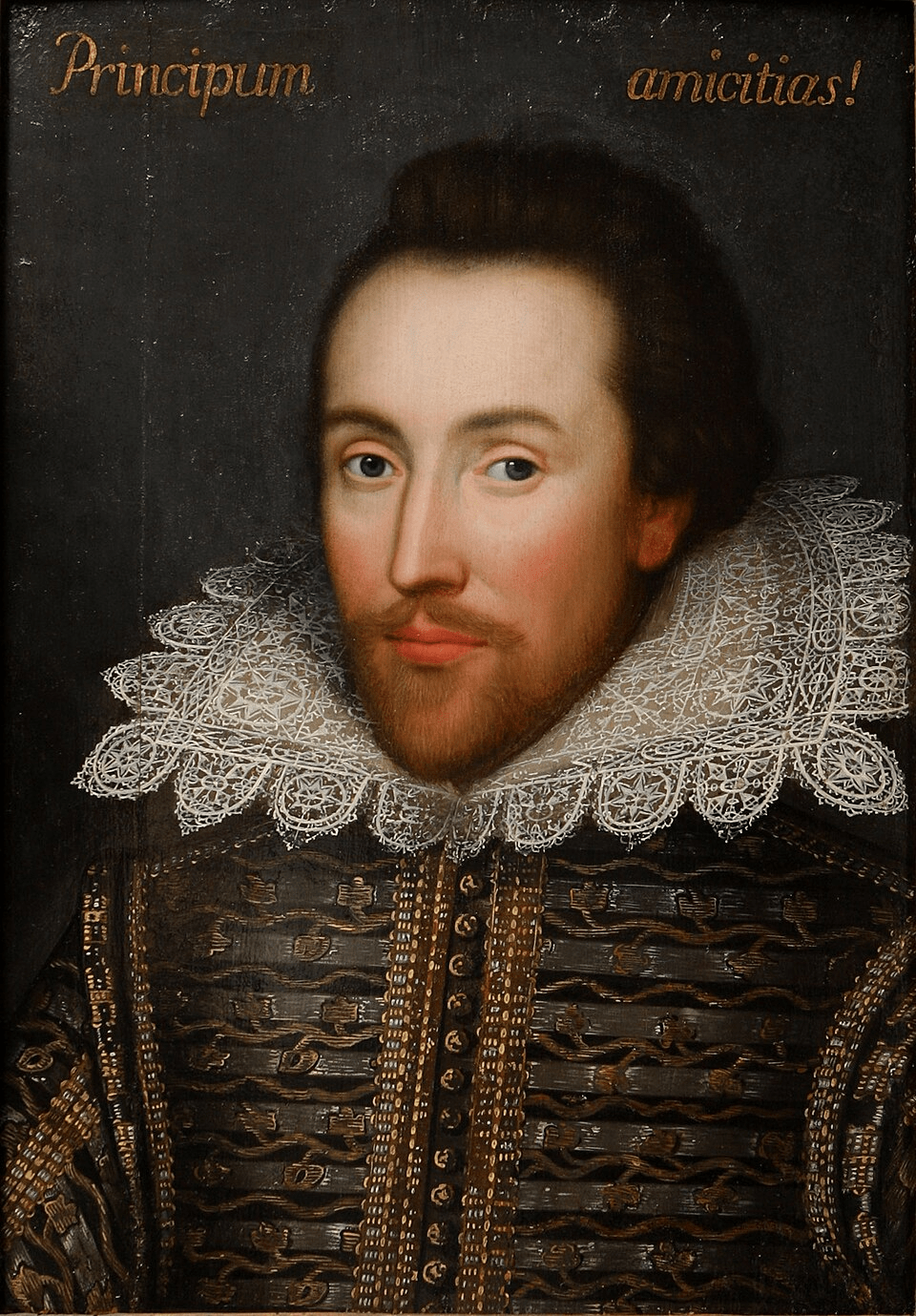
The Cobbe Portrait of William Shakespeare (circa 1610), public domain.

The first post in a series on Shakespeare, pedagogy, and the power of literature to help us navigate ambiguity.

I am a teacher of Shakespeare with a fraught relationship with the Bard. Every time I walk into my upper-level Shakespeare seminar, I hear notes of vocational dissonance, and my imposter syndrome surges.

This tension may have begun when I received a lower-than-expected grade on my Hamlet paper in the ninth grade. Or maybe because most of the performances of his work that I saw before adulthood (and after, if I’m honest) left me feeling like I didn’t quite understand what was going on. Even as I completed my dissertation on 16th-century British literature, my advisor had to nudge me: “You know, you should really let Shakespeare make an appearance.” I did, but reluctantly.

My resistance to Shakespeare wasn’t a response to his canonicity or to problematic depictions of sex, gender, or race—though these issues can be good reasons to evaluate when and how we teach his plays. Perhaps like others who feel pressured by our culture to like Shakespeare but don’t particularly enjoy or understand his work, I resisted him because his plays resisted my interpretive grasp.

My attitude shifted only after I started teaching his plays. I discovered that these interpretive gaps are often what make his work compelling to students, and they give Shakespeare vocational vitality, even today.

As Cultivating Vocation in Literary Studies reminds us, literature of all kinds can nurture vocational exploration and discernment. For David Cunningham, fiction, poetry, and plays have the vocational power to shape faith and to shepherd us through suffering. Literature is full of stories and characters that evoke meaningful conversations on what it means to live a good and purposeful life.

But even beyond what literature says and depicts, the interpretive process itself can also evoke vocational reflection. Moments of difficulty—ambiguities, contradictions, lack of resolutions—become opportunities to wrestle with and return to, postures that can be vocationally formative. After all, our vocations are often circuitous and marked by doubt and uncertainty, as David Youland and Younus Mirza attest.

By vocation, I mean an expansive sense of calling—all the places, people, purposes, and processes that invite our presence, labor, and energy. Some of these are chosen callings; others may have been inadvertently acquired; and still others we may prefer to discard. To adapt a line about greatness from Shakespeare’s Twelfth Night: “Some are born to vocations; some achieve vocations; and some have vocations thrust upon them.”

Together, these callings shape our time, work, and leisure, and we spend much of our lives trying to negotiate their competing claims on us. Often these vocations leave us seeking the ever-elusive “balance” as we find ourselves stuck in the messy middle, not entirely sure how we got here or what step to take next. This reality is no less true of our professional lives than it is of our faith, friendships, marriages, parenting, or civic responsibilities—all those spheres where ambiguity and irresolution thrive. As Paul Burmeister reminds us, our vocations are dynamic and ambiguous, requiring a “fluidity of discernment.”

And so it is that I beckon my students to literature where they witness and wrestle with this murkiness, stretching interpretive muscles they’ll exercise across their vocational lives. And Shakespeare, I’ve found, is especially fruitful for this formation, a topic which Jason Stevens has also explored.

man holding and looking at a human skull
Photo by Никита Кригер on Pexels.com

Shakespeare’s plays are full of complicated depictions of agency, power, abuse, scandal, and sacrifice, themes that play out in the realms of sex, religion, politics, injustice, and tragedy. In watching characters discuss and embody different ways of understanding these ideas, students are compelled not by tidy endings and resolved tensions—we find little of such moments in Shakespeare’s canon, after all—but to the messy display of human dynamics that resist easy solutions and obvious answers.

Last spring, as my students reflected on what their study of Shakespeare had taught them, it wasn’t his poetic prowess or the riveting train wreck of Tudor-era politics that compelled them most. Instead, it was his surprising way of illuminating what they find most puzzling and problematic about their own present realities.

For one student, King Lear became a lens for processing the grief of losing grandparents to dementia. Another student reported thinking back to The Merchant of Venice when he pondered his instinct to avoid certain city streets or to ignore the man begging for money at the intersection near campus. The comedy Much Ado About Nothing catalyzed, for one student, a scathing critique of BookTok and, for another, helped her reimagine the perennial pressures women feel between marriage and independence. In each case, it was Shakespeare’s invitation to wrestle and re-see that drew them in.

Literary scholar Stephen Greenblatt argues that Shakespeare’s “preference for things untidy, damaged, and unresolved over things neatly arranged, well-made, and settled” is a defining trait of his work. “The opacity,” Greenblatt writes, “was shaped by his experience of the world and his own inner life: his skepticism, his pain, his sense of broken rituals, his refusal of easy consolations.” Shakespeare, it turns out, was quite a normal chap.

Shakespeare, it turns out, was quite a normal chap.

He knew the economic and relational pressures of marriage. Church records indicate he married Anne Hathaway (eight years his senior) when he was only 18, just three months before she gave birth to their first daughter. He spent most of his life building a career in London while his wife and children stayed behind in Stratford. He was deeply acquainted with grief, losing his son Hamnet at 11 years old. With high infant mortality rates and average life expectancy between 30 and 40 years, he was surely familiar with suffering and felt the pervasive pulse of fear. His sonnets and soliloquys reflect the psychological turmoil of unrequited love, the fear of being found out, disillusionment with church and state, the fragility of the human body, and the urgency of time’s unyielding march. While we don’t know the specific experiences that prompted these meditations, they attest to a life well acquainted with the tandem roads of joy and sorrow, hope and pain, faith and doubt.

It’s this familiarity that has, over time, eased some of my frustration with teaching his work. If the plays resist my interpretive grasp, they also mirror what it’s like to navigate an often unclear and always tenuous life. In the classroom, these moments of dissonance and disruption illustrate the continued vitality of teaching Shakespeare. In the next three posts, I’ll explore how moments of contradiction, disruption, and irresolution in Shakespeare’s plays have fueled opportunities for vocational reflection and clarity. Beyond what literature says, it’s the very practice of reading it—especially when it’s difficult—that we experience its power to change us and shape our callings.


Julianne Sandberg is an associate professor of English at Samford University, where she teaches first-year writing courses and British literature. Her teaching and scholarship often explore the intersection between theology and literature, and she is the author of Early Modern Literature and the Bodies of a Reformed Eucharist. A participant in the 2025 NetVUE Writing Colloquy, she writes about life, literature, and faith on her blog, A Companioned Life.