Robert Pampel and Common Good Places

On September 12, 2024 Loras College hosted the launch of NetVUE’s “Big Read,” which this year is the book, “Called Beyond Ourselves: Vocation and the Common Good.” This series showcases interviews with authors who contributed to this volume, and this post features Robert Pampel, author of “The University as the Common (Good) Place.”

A series featuring interviews with NetVUE Scholars whose essays appear in Called Beyond Ourselves: Vocation and the Common Good, the most recent publication of the NetVUE Scholarly Resources Project.

On September 12, over one hundred people gathered at Loras College for this year’s launch of NetVUE’s “Big Read,” which is Called Beyond Ourselves: Vocation and the Common Good, the fourth volume of the NetVUE Scholarly Resources Project. Edited by Erin VanLaningham (who also served as this gathering’s host), this new collection of essays brings together a diverse range of voices to consider vocation in relation to the concerns of the common good and communal flourishing. The event featured presentations by four of the volume’s authors, along with a powerful keynote address by Mary Dana Hinton, a conversation between two college presidents, and presentations by faculty and staff from Loras College, all of which aimed to provide educators with ways to think about the roles of leadership and advocacy as we deepen our understanding of the common good as an essential part of vocational exploration on our campuses.

Robert Pampel

This series of posts showcases interviews with NetVUE Scholars who contributed to this volume and generously agreed to respond to my questions about their experience participating in this project, as well as reflecting on their essays and their relation to vocation and the common good. For our first interview, I’m pleased to feature Robert Pampel, who graciously opened the Loras gathering with reflections on his chapter, “The University as the (Common) Good Place.” Robert is currently the director of student academic affairs and associate dean at Washington University, in St. Louis.

Continue reading “Robert Pampel and Common Good Places”

How We Search Now

What if my students think about their vocational discernment like just another Google search? As the question sank in, I wondered whether such an approach to vocation might be feeding certain forms of anxiety in students.

Recently, I’ve begun to accept that an expanding part of my job as a teacher of undergraduates is to help them improve their information literacy skills. Digital culture has exponentially increased the amount of “information” available while also obscuring ways to make sense of it. Perhaps, like me, you can see the resistance flicker across students’ faces when you project the library’s website and broach the topic of search skills. I see students thinking, “Can’t Google just tell me what I need to know?” Perhaps, like me, you’ve worked up a spiel about the value of the databases for which their tuition dollars pay, including caveats about Wikipedia and the risks of broad Google searches made vulnerable to “optimization” and “content suppression.” Only recently did a new question cross my mind: What if my students think about their vocational discernment like just another Google search? As the question sank in, I wondered whether such an approach to vocation might be feeding certain forms of anxiety in students.

Continue reading “How We Search Now”

“Quiet Quitting” and Vocation

To believe that we are called to our work is not necessarily to see work as an end in itself and to martyr ourselves for the cause. Rather, a vocational framework can help us see work as a path that is not good for us if it does not lead us towards self-realization.

The COVID-19 pandemic has shifted our perspective on a lot of things, not least of which may be our relationship with our work and workplace—and hence our sense of vocation and how we communicate it to our students. Even just two years out, I’m startled by memories of things most of us did to make pandemic learning successful: the late-night sessions making Screencast-o-Matic videos, the “check-ins,” the on-the-fly attempts to share audio via Zoom without creating a cringe-worthy feedback loop in the physical classroom. Even if those memories seem distant, though, I—and I’m guessing I’m not alone—still feel bruised by the demands of the last few years. Based on the number of articles about “quiet quitting” that have recently cropped up in my news feed (perfectly timed to coincide with the start of classes), we are only now gaining some clarity about the pandemic’s rippling effects.

Continue reading ““Quiet Quitting” and Vocation”

Richard T. Hughes on Grace and the Paradoxes of Vocation

Richard graciously shares significant moments of rejection and criticism in his life and how these made him reconsider his most deeply held beliefs. He reflects on the influence of Victor Frankl, Robert Bellah, James Noel, and Martin Marty on his life and work, and encourages listeners to consider how “losing one’s self” can be a gift.

Richard T. Hughes

In the latest episode of NetVUE’s podcast series, Callings, we talk with Richard Hughes about his long career as a scholar and teacher. Richard has a new book out, a “memoir of sorts,” which chronicles both his own vocational story and the trajectory of his work on Christianity in the U.S. In our conversation, Richard graciously shares significant moments of rejection and criticism in his life and how these made him reconsider his most deeply held beliefs. He reflects on the influence of Victor Frankl, Robert Bellah, James Noel, and Martin Marty on his life and work, and encourages listeners to consider the paradox of how “losing one’s self” can be a gift.

Continue reading “Richard T. Hughes on Grace and the Paradoxes of Vocation”

Vocation and the Power of Certain Spaces

Reflection and discernment can be amplified in spaces that are slower and quieter than most classrooms, in spaces that have a sense of entering and belonging. Such a room would invite and signal to a student that what we are doing here is different, just as being in chapel and in the lab and studio is different.

Have you ever had an experience of a physical space so powerful and so sudden that it energized your creativity and prompted the open question, “What if . . . ?” This happened to me recently, at the national NetVUE conference in Dallas. During downtime, my colleague Dr. Amy Hermanson let me accompany her on a long walk from our hotel to the site of The Dallas Institute of Humanities and Culture. As we walked, Amy fondly recalled the seminars and lectures she attended at the Institute earlier in her academic career. We were met by our host, Francis Ryburn, who graciously gave us a tour of their facilities at the Stroud House, on Routh Street.

The Stroud House is a modest, late 19th-century brick structure. Originally built as a residence, it was later used as a business center for small, arts-related designers and dealers, and the Dallas Institute acquired it in 2014 through the generosity of Dr. Joanne Stroud, who died in 2021. After chatting briefly with us, Francis offered to show us the interior spaces, which include a couple of large meeting rooms on the second floor. It’s here, in these rooms, where I was immediately impacted by the simplicity, dignity, and possibility of space—for the kinds of spaces that are perhaps needed for thinking about vocation and vocational discernment. These quiet rooms are places in which to dream, reflect, be befriended and mentored, and get clarity.

Continue reading “Vocation and the Power of Certain Spaces”

Teaching and Learning in the Present Moment

When I learned that Thich Nhat Handh died it was like a meditation bell ringing that returned my attention to the present moment. Like so many others, I have followed Thich Nhat Hanh from a distance, reading his books, listening to his dharma talks… This year, I have felt him closer to me in the classroom than ever.

When I learned that Thich Nhat Hanh died it was like a meditation bell ringing that returned my attention to the present moment. My next breath was deeper and calmer. In his death as in his life, he brought me peace. Like so many others, I have followed Thich Nhat Hanh from a distance, reading his books, listening to his dharma talks. I have taught his book Being Peace through the years, both in intro religion courses and in peace and justice courses. This year, I have felt him closer to me in the classroom than ever.

Continue reading “Teaching and Learning in the Present Moment”

Attention, Please: Attentiveness and Vocation

If we succumb to dwelling on the past or living for the future without remaining attentive to the present, we become disconnected from reality.

At the 2021 NetVUE UnConference, Willie James Jennings spoke of attention, or attentiveness, as fundamental to vocation, as the inner logic of calling. He advocated for cultivating students’ attentiveness to themselves, hearing their own voice, as well as of the world around them, hearing with new depth. On the following day, Paul Wadell and Charles Pinches, citing their book, Living Vocationally: The Journey of the Called Life, echoed: “The most basic calling is to pay attention.” Even more recently, Jason Stevens detailed a particular application of attentiveness within his first-year writing courses, quoting Wadell and Pinches at length.

Over the past several months, I’ve found myself coming to a similar conclusion, namely that attentiveness is more than a virtue—that it is, rather, the foundation of every vocational journey, individually and collectively. This conclusion took shape during the spring as I taught a new course exploring the impact and meaning of the twin pandemics of COVID-19 and systemic racism as a lead-in to exploring the broader impact and meaning of pivotal moments for our vocational journeys. Building on several readings used in this course, as well as additional sources, this post is aimed at elaborating on the critical importance of attention and suggesting corresponding applications. 

Continue reading “Attention, Please: Attentiveness and Vocation”

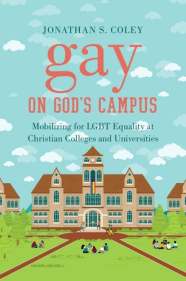
Gay on God’s Campus

An interview with sociologist Jonathan Coley, author of Gay on God’s Campus: Mobilizing for LGBT Equality at Christian Colleges and Universities (University of North Carolina Press, 2019).

An interview with Jonathan Coley, author of Gay on God’s Campus: Mobilizing for LGBT Equality at Christian Colleges and Universities (University of North Carolina Press, 2019). Trained as a sociologist, Jonathan previously taught at Monmouth College in Illinois and now teaches in the Department of Sociology at Oklahoma State University.

Tell us about the book.

The book examines activism by LGBTQ students at Christian colleges and universities. There’s a lot of research out there about how students who are LGBTQ struggle to reconcile their religion, sexuality and/or gender identity on their campus and experience various kinds of trauma on non-affirming Christian campuses. I wanted to understand how LGBTQ students become agents of social change. I examine why students join or form LGBTQ activist groups on their campuses, why they commit to activist groups and sometimes devote several years and many hours a week toward the cause of promoting LGBTQ inclusion on their campuses. I examine what kinds of changes LGBTQ students bring about on their campuses and the strategies and tactics they used to bring about change, and then I consider how students themselves are impacted by their participation and LGBTQ groups on their Christian college and university campuses. I myself attended a Baptist University (Samford University in Alabama) where I worked with other students to start an LGBTQ student group. So this project has personal roots.

Continue reading “Gay on God’s Campus”

Pivotal Moments

An interview with Scott Mattingly, Associate Dean of Academic Life at DeSales University about a new course he developed called “Pivotal Moments: Fulfilling Your Potential in Times of Change,” which was featured in a recent Teaching newsletter published by The Chronicle of Higher Education. Scott taught a pilot version of the course as a one-credit elective this past spring. The interview has been edited for this blog.

Tell us a little bit about the course and how it came into existence. 

I am part of a group at DeSales University that has been charged with facilitating a faculty-driven process for revising our general education curriculum. As that process has unfolded, we have come to believe that we need a capstone course and we are interested in giving students an opportunity to bring together the entirety of their experience, inside and outside the classroom. And the mission of our institution emphasizes more than just job preparation; the importance of holistic well-being, thriving rather than just surviving – those are also important components of a DeSales education. So another aspect to this capstone is that we want to give students a chance to reflect on their identity and purpose – the existential, big questions. So that’s where I started, where we started.

I was pondering that in the back of my mind and then we had these twin pandemics in 2020 with the killing of George Floyd and obviously COVID-19. And I found myself thinking that our students need a way to process what is happening. They are going to do that as part of their social networks and there are probably some courses where it might come up, and maybe some opportunities for programming that students could optionally choose to attend where these things might come up, but I felt like there needed to be something a little more intentional, a little more structured, something that involved the faculty in guiding students through that process.

Continue reading “Pivotal Moments”

The Vocation of Science

When we model explicitly how our vocational framework shapes the questions we ask about our career and work, we open the door for students to do the same, both in their current setting and in future settings as well.

Part of a series of posts written by a team of faculty and students at Calvin University who are developing a curriculum to support team-based research. Their hope is that this blog series will spark a dialog about measures of success that are not typically prioritized in scholarly work and ways this project could be expanded to other colleges and universities, both within and beyond the Christian tradition. This post was written by Rachael Baker, Julie Yonker, and Amy Wilstermann.

In the previous two blog posts, we discussed the framework and some key examples of the curriculum we are developing in (Christian) practices for success in Team Science. In this post, we will discuss how a NetVUE faculty development grant led to a vision for understanding the vocation of science differently and how making that vision explicit is important for engaging students in their own vocational exploration.

Faculty are expected to engage in vocational exploration with students. Sometimes vocational engagement is explicitly addressed through a class discussion, sometimes through an internship or research experience, and sometimes more informally through an advising or mentoring relationship. To teach, mentor and advise students, faculty members need to be theologically literate in the tradition of the institution and grasp how those theological commitments bear on disciplinary issues and questions of vocation. The vocation of the professor is intertwined with navigating callings in themselves and mentoring callings in their students. This multi-faceted approach to faculty vocation requires accurate self-understanding and awareness of the perspective of students. 

Continue reading “The Vocation of Science”