

As pre-health students wrestle with doubts about the paths they’ve chosen or struggle to find their place within the healthcare sector, vocational exploration is more crucial now than it ever has been. In our pre-health programs at Friends University, students want to engage in activities that give them real-life experience to help them navigate these challenges. These students want to know that their learning is useful and applies to their careers—to see with greater clarity their professional futures as they begin their training for it. In short, they want experiential learning.
To help our students gain such experience, my institution has organized professional observational opportunities for them. Initially, we did so to help them fulfill the number of shadowing hours required for admission into graduate programs. Because this shadowing is unpaid, we thought that they would go into these sites grudgingly. Instead, they have loved these experiences and demanded more options and a greater variety of professions to shadow.

Programs in these areas also maintain the importance of applicants having some field observation or shadowing experience. These experiences give students the chance to explore a profession and learn more about it. Given the time and resources that these programs require of both students and faculty, they cannot be mere discovery grounds for the students. Students should know what they are getting into before they apply—to have the chance to experience the professional environment they hope to enter before they pursue the work to get there—so they can stay the course. If they are unable to do so, it can be a waste of the student’s time and that of their teachers. Such experiences are also an opportunity for students to do some soul-searching to see if their natural abilities will allow them to assume responsibility for the professional tasks ahead. It is a moment for them to deepen their sense of vocation as responsibility—to use Margaret Mohrmann‘s language—and learn more about the responsibilities of their potential vocations.

Friends University established its pre-health professional shadowing course to help students decide which area of healthcare they want to pursue, and they have the option to shadow multiple healthcare professionals across multiple semesters. For example, a pre-health student could shadow an occupational therapist, a physical therapist, a physician, or a nurse. We let the students know that they do not have to like what they observe, as that defeats the purpose of exploring these professions through observation. We only encourage them to put their best foot forward, since they might need recommendations from these health professionals if they decide to enter one of these professions. For most students, it is truly a moment of exploration and self-discovery. For example, one pre-dental student shadowing a dentist passed out upon seeing blood during a cleaning, which should have ended the shadowing course. However, the student was fine and was able to check off dental school from her list of healthcare professions. The course also survived.

We have also organized international healthcare exploration trips for students, during which they spend two weeks in West Africa, and in the following year, two weeks in Europe. On these trips, students are housed on campuses that have hospitals attached to them. They do rotations in various departments and observe how healthcare is administered in these parts of the world. These immersions take them out of their comfort zones, and the students often experience culture shock, which brings out qualities and abilities within themselves they might not be aware of. Having left the shadows of their parents, they progress further in becoming their real selves and begin to chart their own paths in the process. On one of these trips, we brought four pre-med students, one pre-dental student, three undecided students, and an aspiring research graduate student. Of the four pre-med students, two stayed the course and were accepted into medical school; one had a change of heart and entered a nursing program, while the other student pursued research in graduate school. The one pre-dental student was accepted to dental school. Of the three undecided students, one became a dental hygienist, one became a lab technician, and one transferred to another institution.

After they complete their observations, students are required to reflect on their experiences. To guide them, we ask them to write a two-page reflection on their placement and explore their level of comfort in these environments, what they’ve learned, what they do not like, and whether they intend to shadow further (in the same profession or another one). These reflections offer our students a unique opportunity to make sense of their college expectations and bring out the meaning they are looking for in college. We have compiled over 100 of these reflections, and the excerpts below represent just a few of the significant lessons that students have drawn from their experiences. Even as the practice of observation may lend itself well to students in pre-health programs, it may not necessarily be applicable to other majors. Still, it might also be creatively adapted for these fields. We also acknowledge that some of our students might be over-generalizing about their expectations of other courses.
“Throughout my time here at Friends, this course has been the most influential and educational compared to any class I’ve taken. In traditional classes, you are to come in, sit down, and take notes nearly every day of the week. I don’t see anything beneficial in that learning style and see it more purposeful with a hands-on approach, where you get to experience what you’re learning. In this class, it did just that. We were able to go out in the real world and sit down with doctors and experience their day-to-day life.”

“The influence of this experience on my career goal was both positive and negative. It showed me that I don’t want to be a family doctor.”
“Shadowing has had a major impact on what I want to pursue. Freshman year I shadowed dentistry but realized that career might not be for me. Last spring, I also attended an information session on applying to a physician assistant program but realized that it was not my calling. In the Summer of 2019, I attended another information on physical therapy and this path is the one that piqued my interest.”
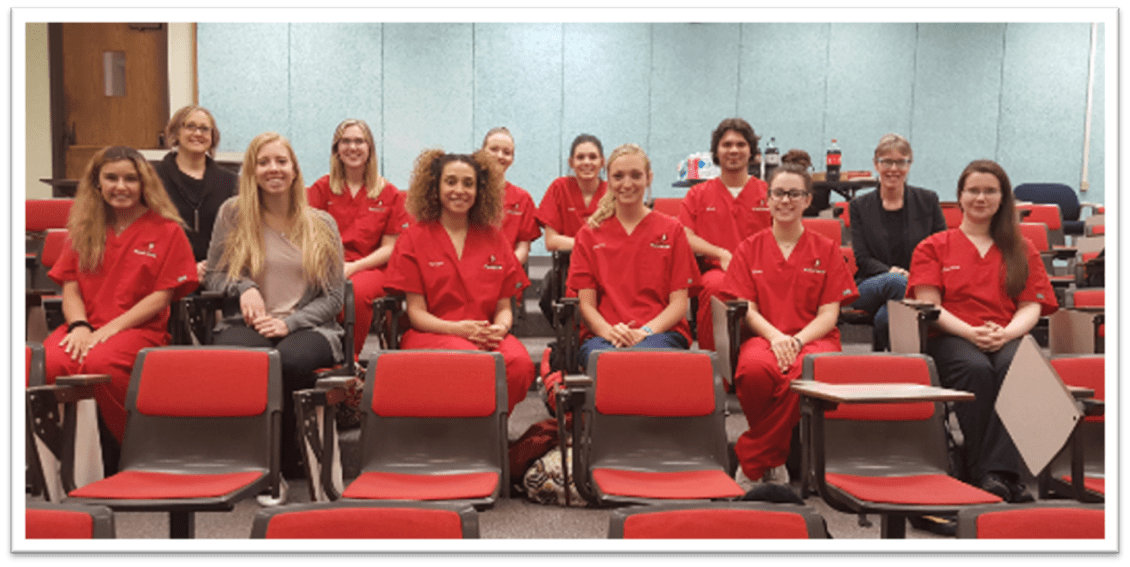
“I found that having the opportunity to shadow at three different schools allowed me to see all of the good and bad of being an OT. Even considering the difficult parts of the job, shadowing solidified that occupational therapy is what I want to do”

“Visiting the hospital in Stoke-on-Trent was an eye-opening experiment regarding medical practices in hospitals. The hospital was teeming with patients who needed treatment, anywhere from simple examination to invasive surgery. I have always known that I was not planning to work in a hospital, but after seeing the Royal Stoke University Hospital, I could see myself being a hospitalist.”
These reflections affirm how much these experiences have meant for our students. We also acknowledge that as we take students out of their comfort zones and observe them dealing with the institutional dislocation and culture shock of such immersion experiences, we learn about ourselves as well. Regardless of the outcome, all of our students return from their observations knowing themselves a little better. As we all aspire to engage students in their journey on their winding paths of vocational discernment, it pays to exit our comfort zones for something out of the ordinary. As they gain practical experience outside of the classroom, students get a small glimpse of the end result—even when they are only beginning their journey.
Prince N. Agbedanu is an associate professor of biology, genetics and biochemistry at Friends University in Wichita, Kansas, where he is also director of health sciences. He is a NetVUE Faculty Fellow, having been a member of the 2022 cohort of the faculty seminar on Teaching Vocational Exploration.