

In my first year as a full-time faculty member, I designed a course that aligned with its stated objectives even as its ultimate outcomes extended beyond my control. I embedded a campus transportation campaign into the course, uncertain whether it would succeed. In hindsight, it was an ambitious undertaking—one that reinforced the challenges and rewards of experiential learning. Such an endeavor is not for the faint of heart, but its impact was transformative, particularly in the ways it shaped my students’ understanding of vocation and their engagement with the common good. Through their participation in the campaign, students began to see their academic work as more than an isolated exercise; it became a way to contribute to a larger community, address real needs, and effect tangible change.
David Matzko McCarthy articulates this pedagogical challenge well:
The daring venture for educators—especially at the university, where the classroom and research area are an individual faculty member’s domain—is to give ourselves over to what students need for a common, coherent education, one that engages the whole campus in terms of human needs, goods, and excellences in all areas of life.

In more ways than one, I knew students needed access to the Chicago Transit Authority (CTA) discounted-fare program: nearly 80% of our students are commuters, with close to 40% coming from the city of Chicago. More importantly, they needed an opportunity to develop their own agency and empowerment by cultivating professional skills at a pivotal moment in their educational careers. As David Cunningham observes, “Yes, these students hope to get good jobs; but they would also like to live good lives.” I sought to accomplish both. With no office of sustainability or designated coordinator, I assumed the responsibility of advancing the initiative.
Teaching this course in the spring of 2023 reinforced a core tenet of purposeful learning for me: relinquishing control as an educator and embracing the unpredictable dimensions of student engagement. To move from theory to practice often also requires us to move beyond rote course projects and to foster immersive, real-time learning experiences. Doing so allowed me to foster my students’ vocational exploration by promoting their sense of environmental stewardship through an innovative course project.
Teaching Life in the Natural World
The course that incorporated my work on the CTA project was called Life in the Natural World. It was a required sophomore seminar that unexpectedly became a pivotal point in our university’s core curriculum—largely due to its common text, Pope Francis’s encyclical Laudato Si’. As a first-time reader, I was struck not just by its contemplative nature but by its imperative call to action. The encyclical transcends environmental theology, urging tangible engagement with ecological and social justice concerns. Pope Francis’s words resonate with particular urgency. “Many things have to change course,” he writes, “but it is we human beings above all who need to change.” His words inspired me to design a course that included three scaffolded units. The first was a written proposal, which required students to brainstorm, research, and problem-solve the best approach in response to the issues raised in the encyclical.

The seminar’s second unit transformed theoretical concepts into praxis through an innovative integration into our undergraduate Scholarship and Ideas EXPO. I structured this unit as a five-week professional simulation, where student committees functioned within an interconnected workflow, mirroring real-world environmental consulting, which included survey design, petition and outreach, board design, and an oral presentation. Each team’s deliverables built upon the work of previous groups, culminating in a presentation team responsible for communicating our collective findings. This vocational approach enabled students to experience how environmental stewardship translates into professional practice.
Aligning our project with the undergraduate EXPO proved strategically valuable as its campus-wide visibility amplified our impact, and the exhibition platform transformed classroom insights into institutional dialogue. Our work even attracted the attention of the dean of students, whose subsequent classroom visit catalyzed institutional change. The students’ contributions demonstrated the powerful intersection of academic theory, professional skill development, and environmental advocacy. This experience illustrated how a required course could evolve into a platform for vocational discernment and institutional transformation.
One of the culminating assignments asked students to reflect on their experience, and the following student response captured sentiments echoed throughout the class:
I mean this when I say this, I was actually surprised by how many people seemed interested in the concept that we had produced. The fact that this idea had applied to so many people, students and faculty alike, was inspiring. I know we had spoken about me running for a position in SGA [Student Government Association], but I felt that I did not have the qualifications nor the skill to be a spokesperson for the student body. But after receiving feedback from actual teachers and faculty here, it changed my perspective in the sense that I indeed have the ability to enforce ideas and convince higher-ups to act on these changes … Along with the support and confidence you instilled in us as a professor, I felt the transition mentally from being skeptical to being hopeful … It’s almost as if I was singing a song perfectly without a microphone and then was given a microphone and was able to get everyone’s attention. That feeling will always be present in my mind now that I have experienced it.
Truth be told, this is what I strive to do as an educator: equip students with skills that endure long after our class ends. I feel a deep responsibility not only to meet students where they are but to propel them forward.
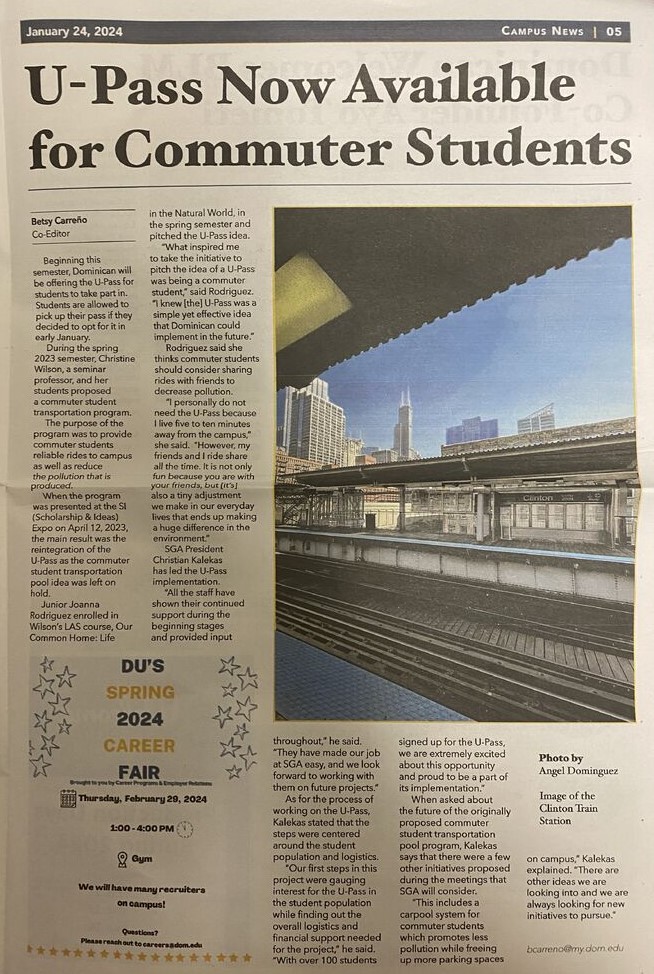
Ultimately, Dominican University became an official partner with the CTA, joining over 30 other Chicagoland institutions. In the spring of 2024, we successfully piloted the program with 80 students, which then jumped to 235 participants during the fall. Much of this increase included students who enrolled at our new living-learning Chicago campus in the Pilsen neighborhood.
These accomplishments might seem minor in the face of today’s reality, where so many decisions seem beyond our control. How am I coping with the federal administration’s whiplash and seismic shifts? By holding onto acts of hope on Substack and Reddit from our dutiful civil servants, knowing that renewable energy sources are overtaking coal, and seeking out the work by strong activists like Beyond Petrochemicals and their community partners, these Montana youth, and New York state legislators. As Fred Rogers reminds us, “My mother always told me to look for the helpers.”
But more than looking for helpers, I remind myself to be one. I am a helper, and a proven one at that. In the face of profound unpredictability, I turn to what I can do—creating opportunities within my own campus community. This course project was a testament to my own abilities, and I encourage my educators to do the same—to push in, not pull back—especially during this time of uncertainty.
What campus projects might we as instructors integrate into our courses? Could your colleague in finance conduct a feasibility study to ensure the campus greenhouse remains financially viable? Might your psychology colleague explore behavioral interventions to help students forgo single-use plastics? Could a faculty member in English guide students in drafting op-eds for the student newspaper to raise awareness of community issues and build coalitions?
As an instructor, I have more agency than I once thought. And that, in itself, feels like a calling.
Christine Wilson is currently a visiting instructor at Dominican University in River Forest, IL, where she teaches in the core curriculum and the English department. Her classroom work was recently published in Dynamic Activities for First-Year Composition (NCTE, 2023). In addition to her teaching roles, she also serves as the transitions faculty co-director and volunteers as chair of the sustainability committee. In this capacity, she spearheaded the university’s partnership with the Chicago Transit Authority, expanding access to affordable public transportation for hundreds of students. Her many vocations include parenting three young children and serving as a school volunteer and sustainability advocate. For other posts by Christine, click here.