
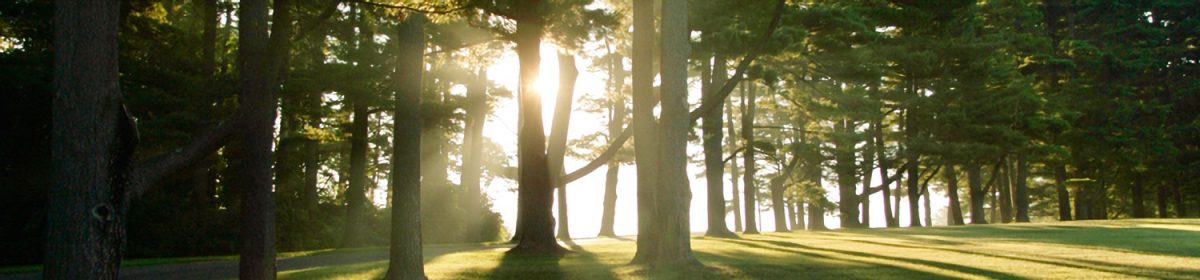
This spring, I took a class on a field trip to the main campus of the Sisters of Charity of Nazareth, a community of Catholic women whose charism includes a call to live sustainably and work for environmental justice. Some of our course texts highlighted the natural world as an emerging source of spirituality among nonreligious young people in the US, and I wanted students to see that many traditional religious communities find God in nature, too. The question was how today’s “nones” might resonate with, well, nuns.

On a beautiful Saturday in April, we walked the immense campus and heard the Sisters’ attention to the land is rooted in their love of God and all that belongs to God. The following Tuesday, I asked the students what they had learned on the trip. My focus on course content had me looking for evidence of learning in conceptual connections, so when students’ initial responses provided such evidence, I thought “great, objective achieved.” But then someone offered a different sort of comment: “What I really liked is that we were outside walking and talking with each other. I feel like I got to know people. Obviously I’ve seen you guys all semester, but I hadn’t really seen you. Just being together like that is what will stick with me. I learned I should do it more.”
Genuine human connection: another objective achieved! Yet it hadn’t been an explicit objective because, to be honest, the weight I give to conceptual learning often relegates connection and friendship to the periphery. When it happens, wonderful, but it’s not really the goal. How might my teaching change if I acknowledged that developing a capacity for friendship is a fundamental component of the overall process of learning?

Many faculty will greet the idea of incorporating friendship into their teaching with skepticism. “Friendship isn’t my discipline,” they might say. Or, more forcefully, “you can’t tell me what to teach.” Wendy Brown, in her recent book Nihilistic Times: Thinking with Max Weber, challenges professors to supplement our valid concerns about academic freedom with a consideration of academic responsibility. What are our responsibilities in this moment, as educators? To answer this question, we need to consider carefully the kind of world we live in and its formative effects on our students. As Brown describes them, “No generation has ever stared so directly into its own lack of collective future while managing such intense, complex requirements for building its personal and immediate one.” The world is on fire, political institutions are crumbling, societal breakdown continues its online acceleration, and cynical partisanship erodes the meaning of truth, but make sure you pick the right internship to build that resume. “This predicament is too much for many young spirits,” Brown suggests, “essentially demanding that, with their heads down, they put one entrepreneurial foot in front of the other as if they were not walking toward catastrophe.” This is at least part of the context in which our responsibility as educators takes shape. Surely we cannot live up to it by confining ourselves to teaching students methodologies and scholarly standards in our various disciplines.
Teaching friendship is a useful way to think more broadly about our responsibility to students in the present context because a tangible effect of recent societal shifts is dehumanizing loneliness. A US Surgeon General’s report from last year calls loneliness an epidemic and a public health crisis. Although we may be around others or connected to them virtually, we have lost or forgotten genuinely human habits of affection and intimacy, as my student was pointing out in her comparison of the classroom experience and our field trip. The fact is that many college students have come to expect isolation and invisibility, even in group settings. This situation was undoubtedly exacerbated by the pandemic and the shift to online learning. Thinking about education in terms of “delivery methods” unfortunately convinced many of us that learning is something to be delivered rather than something we must cultivate together. Returning to the classroom will not be enough. We must learn—and teach—how to be together as fellow human beings.
How can faculty members become better at cultivating the kind of togetherness that builds the capacity for friendship? I think it starts with practicing it among ourselves. At minimum, this means spending some regular time with colleagues without an agenda beyond the cultivation of friendship—in other words, anti-meetings.. True friendship involves a blessed squandering of time, which is to say that it exceeds organizational measures of efficiency. That does not mean that it has no effects, however. When students can sense even amid inevitable tension and disagreement that faculty and staff members know and care about each other as people, they may feel hope that they, too, will find real connections in a challenging world.
True friendship involves a blessed squandering of time, which is to say that it exceeds organizational measures of efficiency.
Experiencing friendship ourselves also prepares us to name love as the central component of a good life. Talking about love with students is challenging because the word is often misused and hard to define. But I have seen that students want to talk about it anyway. I recently assigned a book by the poet Christian Wiman that equates life and love with God. In other words, for Wiman, there is nothing higher, and nothing more real, than love. I asked students if they agreed that having all the usual measures of success in life but lacking love would be less fulfilling than having love without those things—the very things that, ostensibly, they are working toward as prospective college graduates. There was some initial confusion, as several admitted to associating love solely with romance. But eventually consensus emerged that love is also the source of friendship and maybe even of learning. The philosopher Kathleen Dean Moore captures this idea when she insists that you can’t seek truth without love, whether you’re doing it through literature or sociology or the biology lab. “To hold something in your hand, to attend to it, to be astonished by it, to devote your life to its mysteries- [. . .] to honor it by listening closely—isn’t this what scientists do each day? There is more than one way to love the world.” To pay attention, to devote your life to the world’s mysteries—these are acts of both learning and love. And students will have a hard time believing that life’s mysteries deserve their scholarly attention if we never acknowledge their own depths as human beings.

Certainly, most of our schools already employ wonderful staff members who attend to students holistically. Yet instead of relegating that work to the “non-learning” side of the college experience, faculty members should pay it more attention. This was brought home to me at the end of Baccalaureate Mass one year, when graduating seniors gave reflections on their college journeys. I found them striking. Each speaker described the university as a community, in which they had discovered surprising sources of support and discerned challenging yet rewarding obligations. Without exception, they exemplified not just scholastic accomplishment but the development of their capacities for friendship and humanness—the makings of a good life. I was moved to hear stories of students coming to know that they were seen, supported, and empowered to see and support others. I also noticed that the people mentioned by name were exclusively staff members—our director of campus ministry, a campus security officer, student affairs staff members, dining hall workers, and more.
My point here is not to encourage faculty members to horn in on the great work done by staff members but simply to highlight that students often emphasize friendship when expressing their gratitude for their college experiences. And we shouldn’t be surprised. In a world that seems to promise division and loneliness, nothing is as powerfully transformative as trustworthy practices of accompaniment. Living up to our responsibility as educators in this moment demands that we incorporate these practices more fully in our classrooms. Arrange tables and chairs so participants can see one another during discussions. Talk openly about the connections between learning, love, and life satisfaction. Reimagine classroom time as cultivated togetherness rather than as content delivery sprinkled with occasional socializing. Trust that seeing and listening to students as human beings is not peripheral to their educational journeys. In graduation reflections and field trip feedback, they’re already telling us it is central. Honoring the mysteries of their humanity by listening closely gives them confidence in the world’s worthiness for their own caring attention. In this respect, friendship isn’t an optional supplement to genuine learning; it’s the whole ballgame.
For further reading on friendship and learning, see Jason A. Mahn’s “Hearing the Call to Action” and Hannah Schell’s “With a Little Help From our Friends.”
Justin Klassen is an associate professor of theology & religious studies at Bellarmine University in Louisville, Kentucky, where he also serves on the Mission Council. He is a NetVUE Faculty Fellow, and was a member of the 2021 cohort of the Faculty Seminar on Teaching Vocational Exploration. He is the author of a recent op-ed on the value and purpose of a college education. For more posts by Justin, click here.