
The first post in a series exploring the connections between vocation and pedagogy.
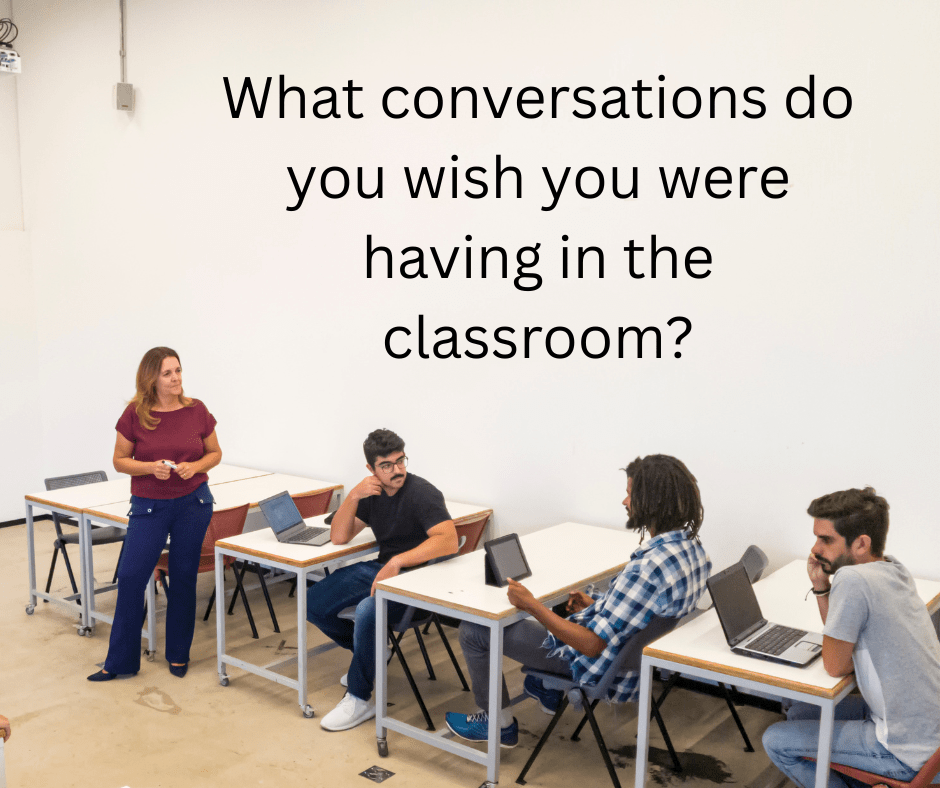
“What conversations about meaning and purpose do you wish we were having in the classroom?” I asked a group of my senior students and then held my breath. When I first began thinking about vocation, I felt overwhelmed by both the possibilities and the challenges of integrating it intentionally into my teaching. To help me do so, I invited my students to help me understand what they needed so that we could imagine what was possible. They were eager to engage, and their ideas jumped quickly among three elements: the content of the conversations, the possible structures for activities, and the culture of the classroom. As my students shared their thoughts, they connected content and pedagogy in ways that encouraged me to think more carefully about designing possible activities to give shape to and reinforce the unfolding conversation. It was the beginning of my learning journey, which has led to many interesting observations of the reciprocal relationship between vocational exploration with students and general pedagogy.
In this first post, I want to consider vocational and pedagogical hope in the classroom. Students are shaped by the hopes we hold for them and the value we see in them. Engaging vocation invites us to see our students not merely as the receivers of learning but as people whose experiences, skills, and passions have value. It challenges us to consider how our interactions contribute to their discernment and flourishing. To view students vocationally is to embody hope for them, as Paul Wadell so aptly describes. We cannot think vocationally without hope, and the learning spaces we create contribute to communicating that hope to our students.
Encounters with Educational Hope
My most powerful encounter with hope occurred last year when I answered a call from the teacher of my neurodiverse child. Expecting the usual bad news, I teared up when she said, “We think Jamie is emotionally and educationally ready to move on to middle school.” Jamie—a pseudonym my child requested I use—was in fifth grade at the time, and it was the first call I had ever received from a school that was not about a problem we needed to address.

For many years, Jamie attended a school that was not the right fit. I could fill many blog posts with stories about the tears shed over the challenges we faced there, but we fundamentally disagreed over whether Jamie needed better support (me) or more behavioral consequences (the staff). In January of 2023, we pulled Jamie from that school with no idea what we would do for the rest of the academic year, but we were confident that not attending would cause less damage than continuing to send them to a place that told them every day that they were not good enough.
Recently, we read through Jamie’s report card, and their teacher used words like “bright” and “leader” to describe Jamie. As we reflected together, Jamie said, “I think my old school might have been wrong about me being a defiant and rude person.” In retrospect, I can see that the difference between the two schools was the contrasting absence and presence of hope. Jamie’s new school sees Jamie for who they are and actively lives into a hope that they can have a meaningful and worthwhile future. Teachers there embrace Jamie’s love for rare flightless birds and make space for that interest in their learning; they believe Jamie has valuable things to say and offer alternative means of expression so Jamie can share those things with others. As Jamie walks into school each day, they physically stand up tall, feeling they have permission to take up space. The presence of hope at this school has given Jamie permission to have their own hope.
Walking this educational journey with my own child has challenged me to think about the hopes I have for the students I teach. Are students able to stand tall when they walk into my classroom? To see students through the lens of vocation requires me to consider them as whole, complex, and valuable individuals. I better recognize that students have been shaped by their own unique times and places, some of which will be invisible to me. Vocational thinking brings me to questions of how to value and make space for embodied students as learners in my classroom.
Connection to Pedagogical Frameworks

One pedagogical tool that has been helpful as I think about how to embody an authentic welcoming space for my students has been Universal Design for Learning (UDL). UDL is a framework for course design that asks teachers to anticipate possible student needs and incorporate accommodations into the design of the course. Three key principles for UDL are to provide multiple means of (1) engagement for recruiting interest and sustaining effort, (2) action and expression for language, symbols, and comprehension, and (3) representation including support for executive functioning. As described in this helpful book on implementing UDL in higher education, “Instructors who embrace UDL can rethink the mix of strategies they use and ensure that the overall mix, as well as the implementation of each strategy, is welcoming to, accessible to, and usable by students with a wide variety of characteristics.”
The principles from UDL have made their way into my course design process in various ways, depending on the course level and content. Some examples include:
- Presenting new course content in multiple formats to support different kinds of student engagement;
- Rotating responsibility for taking and sharing class notes;
- Offering extended-time testing (usually time and a half) to all students without requiring special arrangements;
- Providing clear guidelines and expectations for activities like small groups discussions so students understand their roles and how to collaborate productively;
- Giving students some choices for the medium they use to complete assignments, especially those involving personal reflection.
Developing these structures takes work before the semester starts but is well worth the effort. When I’ve done so, students know I have created intentional space for them to be successful in my course because I value them and the things they have to offer to our collective learning. More broadly, different kinds of learners can walk into my classroom and find space to engage meaningfully in the classroom.

Attention to these pedagogical design elements has also made it easier to invite students into conversations about vocation. Within a course based on UDL, students are more comfortable and engaged; they are often more ready to accept my invitation for the vocational conversations that I weave throughout the class. Reciprocally, the vocational assignments and conversations that I bring into the classroom align well with UDL’s goal of engagement; in particular, vocation offers unique ways to recruit student interest, and to sustain their efforts and persistence, through connections to their own experiences and hopes for their futures.
Vocation has broadened the way I think about students and has challenged me to refine my pedagogical practices, making me a better teacher in the process. Thinking about teaching vocationally was what first brought me to the important pedagogical questions of how to create welcoming learning environments, which in turn become more inclusive of all learners. The attention to design allows me to communicate my vocational hopes for students—not just in the conversations we have, but in the pedagogical space I cultivate for those conversations. Importantly, this work has not been in competition with other goals in the classroom: the intentional investment in creating welcoming spaces has not only supported vocational discernment, but has also benefited every aspect of our engagement and learning together.
Rachael Baker is the associate director of NetVUE. For more posts by Rachael, click here.
