

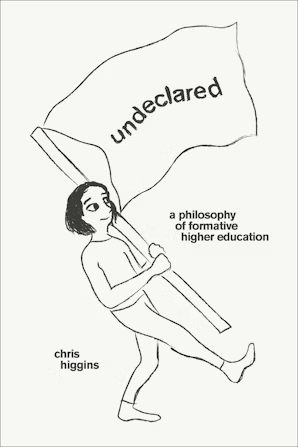
In his new book Undeclared (available via open access from MIT Press), Chris Higgins usefully criticizes the “jobbification” of the contemporary university. In its place, he describes an ideal of vocational formation that both inspires and has the potential to guide our actions.
The final chapter of Undeclared begins with a familiar dilemma. A humanities department is called to justify their budget and faculty lines (if not its very existence). In response, Higgins offers what may seem like a counterintuitive suggestion. Rather than argue for how the humanities prepare students for the job market, or defend the separation of humanistic inquiry from vocational concerns (even though both have the virtue of being true), Higgins suggests that an expansive vision of vocation can reinvigorate humane learning in our time.
Vocational formation, as Higgins understands it, is a life’s task. It is an expansive project that calls on our whole self and demands that we seek out the best thinking available to us. For Higgins, it includes six key elements (p. 206):
- Finding a worthy form of work to which you are suited.
- (Acquiring technical proficiency in your chosen field.)
- Cultivating the ethical understanding necessary to enact your vocation with integrity and public purpose.
- (Determining how to land a position in your chosen field.)
- Learning how to grow into and through your work.
- Learning how to grow out of your work, if and when the time comes.
The tasks that Higgins places in parentheses “are the bread and butter of the contemporary university” (p. 206). The other four tasks offer a vision of what humane learning for vocational formation might become.

One’s vocation includes the work that one will get paid to do, and the ways that our work impacts the ethical and moral dimensions of our lives. Humane learning for vocation allows students to integrate their passions and their ethical and moral ideals into how they work and conceive of a life of work. Rather than narrow higher education to a credential that leads to a job, Higgins wants us to see how a college education can help students discern their vocation while preparing them to remain open to the ways that work will call us to continued learning and growth, often in unexpected ways.
This is why his fifth point strikes me as so important. Some students feel so much pressure to get a job that they fail to consider that this initial step is just the beginning of the adventure. A humane education can prepare a student to get a job and grow into and through the work. In my field of teacher education, many teachers feel tremendous pressure to gain the knowledge, skills, and habits of mind that will allow them to effectively and ethically teach starting their first day in the classroom. Unfortunately, this goal—as important as it is—can foreclose the important insight that the meaning and value of a life of teaching is never exhausted. In my own experience, the more proficient I become as an educator, the more I see how much more there is to learn about my life’s work.

A college student who aspires to teach tends to focus on the first days and months of teaching. This is understandable. But a humane education must also help college students reflect on the joys and pleasures of growing into and through their work. To do this, we might read memoirs of teachers like Vivian Paley or Julie Diamond. Through these texts, we not only gain tips that we can use in our classrooms, but we also learn an ethical stance toward our calling. We see that teachers who love their work forge connections to the intrinsic value of the work of education. They grow in their ability to connect with every student, in their connection to the subject they teach, and in their self-understanding of what it means to be a person who is called to teach and is devoted to the work of teaching.
Point three is related but different. Drawing on thinkers like Charles Taylor and Alasdair MacIntyre, Higgins suggests that the jobbification of the university follows larger social trends that prioritize instrumental thinking. The instrumental university focuses on credentials and narrowing education to measurable outcomes. Offering an alternative way to think about humane learning, Higgins argues that an undergraduate education can promote practical reasoning. Such reasoning is far broader and more expansive than instrumental forms of thinking, where reaching an end is prioritized over reflecting on which ends are worth pursuing in the first place.
To implement Higgins’s vision and promote practical reasoning, we need to dismantle dualistic thinking as it relates to vocation. College shouldn’t only be about getting a job, nor should humanistic thinking eschew our students’ more pragmatic concerns. Humane learning has a great deal to offer students as they consider a life of work. If a student gets in the habit of instrumental rationality, thinking that the entire purpose of college is getting a job or a credential, they may bring this narrowing thinking with them into the workplace. And when this happens, a student may develop the kind of “heedlessness” that MacIntyre describes in a lecture he gave at the University of Notre Dame.

A student who thinks instrumentally may not ask questions about the broader social, political, or moral impact of their work, which can undermine their personal integrity and harm the public good. To avoid this, we need to create learning opportunities that expose students to wise practical reasoning in their chosen profession and across a range of professions. Key staples of a humanistic education—film, fiction, memoir—give students opportunities to witness this practical reasoning in action. As Higgins demonstrates, we don’t have to choose between narrow job preparation and humanistic education divorced from the workplace. Rather, we can rethink humane learning as an education in practical reasoning that is essential to living a good life inside and outside of one’s chosen career.
Faculty want their work to matter. Students are hungry to ask big questions and desire meaning and purpose in their lives. Higgins’s vision for vocational formation is one way to connect these dots. I strongly encourage readers of this blog to read Undeclared, and I look forward to being a part of conversations in which we tie even more directly core aspects of humanistic education to cultivating the practical reasoning skills and moral vision of our students. Doing so, I believe, will have the salutary effects of helping students engage more deeply in their educations while also preparing the next generation to do good work with integrity and public purpose.
Jeff Frank is professor of education and chair at St. Lawrence University in Canton, NY. He has published two books as a philosopher of education: one on John Dewey and engaging students in the present, and one on what it means to be a liberal educator. To read more posts by Jeff, click here.
