

The practice of discerning and living into one’s callings is often deeply influenced not only by overt barriers but also by implicit messages that shape what seems possible in our lives. As a child of the 1980s, I yearned for representation that countered the oppressive gender roles in the world around me in the small northern Michigan town where I grew up. Most viscerally, I noticed my own discomfort with the pervasive narrative that I would have a husband and children someday, regardless of what my paid work would be. In my adolescence, queer life was invisible; but when I listened to music, I experienced a sense of being-in-community and was invited into self-reflection about who I was called to become.
I was a high school sophomore when the now-iconic folk rock duo the Indigo Girls released their two-disk live album 1200 Curfews. It was autumn 1995, and our local Kmart department store boasted an interactive display inviting shoppers to select a CD cover image and listen to a sample. The result of my haphazard button-pressing one day after school? Three decades later, the Indigo Girls continue to shape the rhythms of my adult life and the ways I hear my callings. For me, their music is a call to kindness, community, and social action. It is a call to use our voices and to use them to lift up our neighbors’ voices. It is a call to bring people and our stories together across differences and in shared purpose.
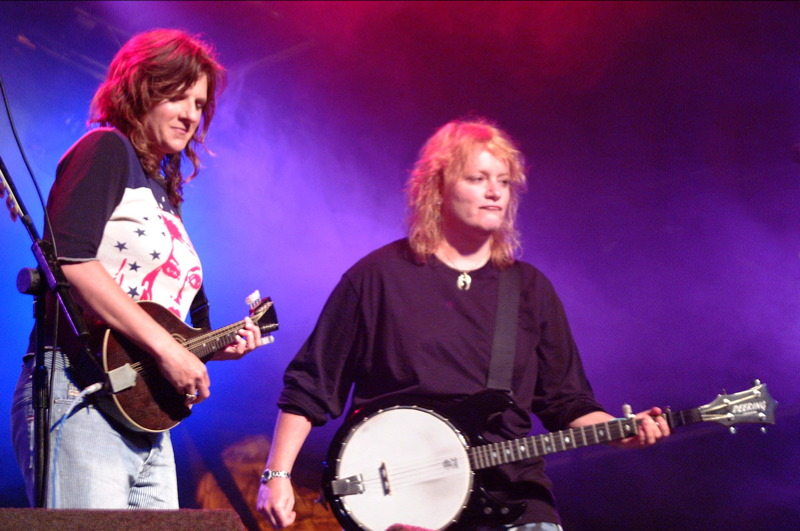
That day at Kmart, I listened to a clip on repeat of Emily Saliers and Amy Ray covering Buffy Sainte-Marie’s “Bury My Heart at Wounded Knee.” I was spellbound by the confluence of gritty and ethereal vocals against a backdrop of heavy guitar and drums. At the time, I did not know that this song was a centerpiece of the Indigo Girls’ sets during their Honor the Earth tour, which raised funds and awareness for the non-profit of the same name that centers Indigenous sovereignty and environmental justice in its mission. I simply understood that they were singing about something bigger than themselves, and I felt moved to learn more and to contribute.
When I first discovered the Indigo Girls, I also did not know that Amy and Emily had been out as lesbians since the late 1980s, nor that I would soon meet my first girlfriend. But I did recognize that I desperately craved the energy, provocation, and harmonies of their voices. I certainly could not have anticipated how unwaveringly I would be sustained and encouraged by their music until this very day. That through their lyrics I would discover my own moral compass and the transformative thrust of poetry. That leaning into the layers of meaning in their songs would prompt me to develop habits of reflection necessary to help me discern and embrace my own journey. All I knew was that the Indigo Girls spoke directly to my heart and that I was compelled to listen and to sing along.
1200 Curfews includes bits of Amy and Emily’s banter with the audience and their characteristic “thanks y’all” in response to riotous applause, which left me feeling wholly present for their performances. Many years before I would physically attend my first concert, I was moved by this experience of being-in-community. In an episode of On Being with Krista Tippett, Amy and Emily discuss this interconnectedness of music and spiritual life in ways that resonate with my personal experiences and those of so many devoted fans. When I reflect on this dynamic today, I recognize it as integral to what Karen Tongson articulates as the Indigo Girls’ “enduring, communitarian project of world-building.” In A Song to Sing, A Life to Live, which Emily co-authored with her father, the renowned theologian and church musician Don Saliers, they further explore how music serves as a bridge between the secular and the sacred.
Friends often chuckle at my ability to find an Indigo Girls song for any occasion. If I need to get something done when I’m feeling low or stuck in my head, I play “Hammer and a Nail”:
now i know a refuge never grows
from a chin in a hand
and a thoughtful pose
gotta tend the earth
if you want a rose
When I need to be reminded of the call to neighbor love over divisiveness, especially in relation to those whose actions, votes, and words dehumanize the most marginalized among us and who choose violence over connection, I listen to “Tether.” And I feel steadied in the pursuit of an activism that is as kind and compassionate as it is forthright:
i see this world
battered but not broken
there’s a fallow heart it’s
waiting on a sowing hand
and you can grow what you want
but one day it’s gonna rise up
so plant what you need
to make a better stand
Both these songs, personal vocational anthems of mine, emphasize how precious our lifeforce is while also compelling us to reflect deeply on what we choose to do with our time and energies. Whereas “Hammer and a Nail” calls us to shift from reflection to laborious action, “Tether” plays on the idea that, not unlike the earth, “a fallow heart,” too, invites us to tend it. The line “to make a better stand” reminds us that we can plant seeds of cooperation or discord in ways that echo the “do we tether the hawk, do we tether the dove” of the song’s refrain.
In “All That We Let In,” the metaphor of agricultural labor and the common good is replaced with other kinds of paying attention and making—notably knitting, writing a poem, hearing the call of birds’ song, and cooking supper for a beloved. Simultaneously, the song evokes entropy—the undoing of things—and with it, the reality of human mortality. In the second, fifth, and final stanzas, the lyrics reference this inevitability through the phrases “centerline / and the brutal crossing over when it’s time,” “crosses on the side of the road,” and “names in stone” respectively. This progression replicates a trajectory between death and remembrance, and the following stanza anchors all the ways in which we opt to show up for life, for love, and for a world that needs us—not despite the precariousness and inherent sorrows, but rather because of them:
but we’re in an evolution I have heard it said
and everyone’s so busy now, but do we move ahead
planets hurling and atoms splitting
and a sweater for your love you sit there knitting
If knitting a sweater—a bodily and time-consuming act—is a way of giving form and interconnected dimensional purpose to a single thread, it also represents the abundant gift of a life lived fully, intentionally, and in communion with others.
As soon as Alexandria Bombach’s 2023 documentary Indigo Girls: It’s Only Life After All was available for purchase, my partner and I cozied up on our couch to take in the film. I laughed and sobbed and experienced a sense of kinship with all the fans singing along at concerts, raising signs in protest, and working to move the needle on social justice. I imagined expanding the nascent ideas captured in this post into a full-fledged course. My students and I would engage the Indigo Girls’ expansive discography as a tool for vocational reflection, an archive of political action for the common good, and a world-building mechanism. On the first day of class, I would unironically wear a prized item of concert merch: a grey T-shirt that reads “Indigo Girls University.”
Kiki Kosnick is associate professor of French, Francophone studies, and women, gender, and sexuality studies at Augustana College in Rock Island, Illinois. K’s recent work on queer and feminist approaches to gender-inclusive poetics and language pedagogy has appeared in Modern & Contemporary France (2019), Teaching Diversity and Inclusion: Examples from a French-Speaking Classroom (2021), and The Modern Language Journal (2023). K is a NetVUE faculty fellow, having participated in the 2019 NetVUE faculty seminar, Teaching Vocational Exploration. To read more posts by Kiki, click here.